


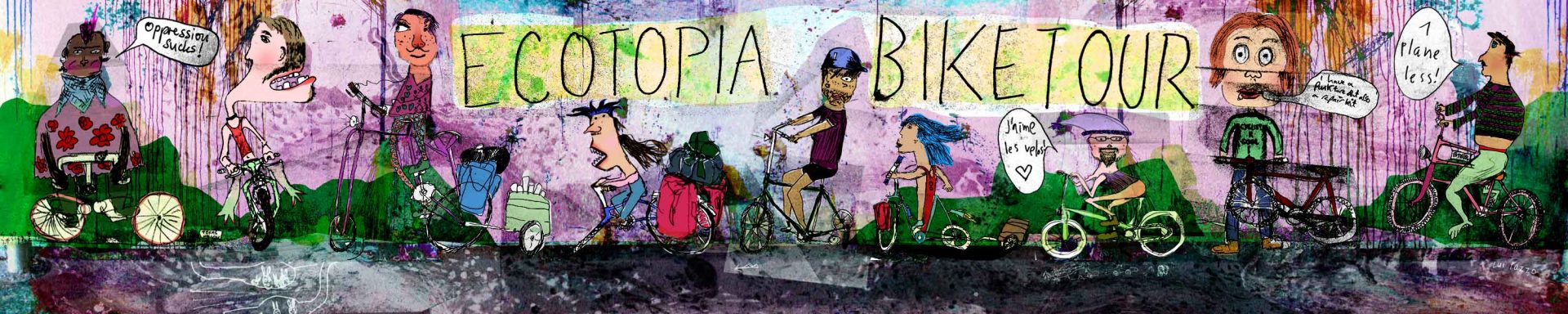
Trollhättan – Oslo: “We do it for fun”
15.08.2026 Arriving at Bodasjön Lake
Ystad – Trollhättan – Bodasjön Lake
The journey started with worries. Will the train to Świnoujscie arrive on time? Will they let me pass without a reflective vest, which turned out to be required when riding a bike with cars? Will I find the way to the ferry quickly enough? Will somebody steal my bags while I’m in the bathroom? People snoring didn’t help with sleeping, and the reclining seats, although mostly empty and allowing one to lie in a horizontal position, were much worse than sleeping on the floor. But I was too worried to move to the floor — who knew what rules they had.
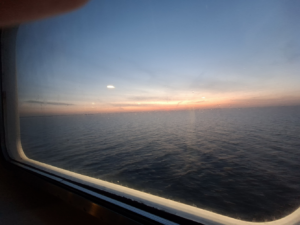
A voice announcing our arrival woke us up around 4:30. I quickly packed to use the shower, although it turned out to be not as popular as I expected. Maybe not that many people fancied the experience of being transported naked in a small wet rocking box with dim light.
I had problems finding the deck with my bike, and later the corner where I left it. When getting out of the ferry, I worried again about the absent reflective vest. I also didn’t check the rules for riding bikes in Sweden in general, and, fearing fat fines, I attached all my lights to the bike and turned them on. Then I hesitantly approached the passport control booths. Cars were driving slowly, and I was mustering courage to jump the line. When I was already very near the port workers, I tried to make eye contact with them. They persistently didn’t look at me, so I rode on, relieved that the first passage stage was over.
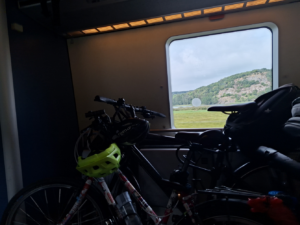
The train experience was smooth: there was always space for my bike (which was not guaranteed); the Skånetrafiken app worked well; ticket inspectors spoke English. Strangers wished me luck on my trip. Ecotopia people sent me a tip to change trains not at Malmö C, but at Malmö Triangeln, because there’s just one platform on the latter, which saves you the time and worries about having only 3–4 minutes for the transfer.
I was even too fast hopping the trains — there were changes in the group’s plans on which city they would be closest to on that day, and I thought I should go to Trollhättan, but when I sat on the train there and bought the ticket, I opened the chat and read that they would be closer to Lödöse, so I had to travel 25 km back instead of 9 km forth. I felt frustrated with my hasty decision-making, but in the end I didn’t have to travel the same route again, so I got to see a cool rail bridge of the Norge-/Vänerbanan railway over Slumpån river.
Then I had lunch with a view of a wall of rocks. My bean can didn’t open with a pull tab, which I just tore off with no effect, so I had to use a knife. That led to the first spilt blood. I wiped it on the leaves of some bush, asking creatures of the woods to accept this in exchange for good fortune during my trip.
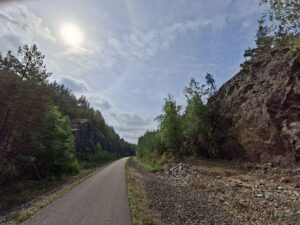
When near the camp, I was close to losing control of the handlebars while racing down a steep, gravelly slope, with my bike much heavier than usual. It was a good preparation, since the bike was about to get even heavier with the communal bags.
I arrived at the camp at around 3 pm, and people were smiling at me, introducing themselves, and inviting me to eat lunch with them: a salad with iceberg lettuce, sunflower seeds, cucumbers, and of course apples, Ecotopia’s staple. We shared the camping spot with at least two big ant houses, and the ants sometimes interacted with us. Not biting, but «affectionately nibbling». All the people were new to me, but it felt cosy and familiar.
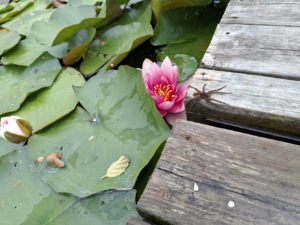
We had a group walk and saw water lilies and a giant spider with hundreds of tiny spider children. We were observing them for quite a while in proximity, and then joked that some of those small spiders might travel with us, on us.
Conclusions:
— Have a reflective vest with you when planning to travel by ferry, at least in Poland (at least in Świnoujście).
— Note down the deck you left your bike on and try to find big distinctive objects near your bike to later find it among many almost identical decks and corners.
— If arriving at a campsite with other people there, ask about detected tick nests before putting your tent somewhere.
— Be careful with tin cans unless you’re into blood sacrifices.
16.08.2026 Arriving at Vänern Lake near Vänersbourg
Trollhättan – Vänersbourg
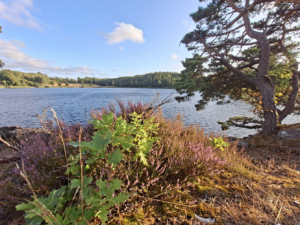
I had more hours of sleep than usual thanks to going to bed at 8 pm, because I wanted to compensate for the ferry experience. The forest floor was graciously free from rocking and 4 am announcements.
Between my first and my second breakfast, I enjoyed a conversation on shoplifting. It sounded like a topic frequently arising on tour, and the first morning was a high time to jump into the discourse. We didn’t have an infinite amount of time, which would be suitable for such a subject, so I kept some thoughts for the future.
Before leaving, I had to say some goodbyes, because it was the last day of the tour for some people. The group was much larger before I arrived. I heard of 30 people — now, about nine planned to reach the next camp. I was the last new person to join the tour; from then on, we were getting smaller.
When leaving the camp, I took the full trash bag with me to try to get rid of anxiety about leaving earlier than others and not helping with packing. We were far away from towns, so I left the bag in a big can for mixed waste at a crossroads. A rocket stove was sadly about to join it, because a decision was made to reduce the weight of our communal belongings, as the size of the group shrunk. Some persons selflessly went on a mission to a postoffice, to mail a trailer and some other things to Germany.
I had lunch at Drottningtorget square in Trollhättan because there was a drinking water tap there which actually worked. The meal left from yesterday made me worry (like many things do), because it had no protein and was mostly wheat. That is a product that makes my stomach hurt slightly, but blood tests for now have not confirmed any diseases or allergies, so I just feel unease around wheat. But with my travelling mode on – that is the energy-saving mode — I chose not to refrain from it so as not to create additional food quests.
Unaware of the benefits of my choice, I picked the communal breakfast bag as my transportation duty for that day, so I had peanut butter to spread over pasta with tomatoes, so at least the protein problem was solved.
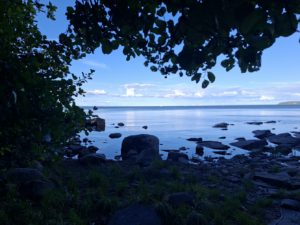
After arriving at the camp, I immediately went to swim. The Vänern lake, the third largest lake in Europe, was calm and transparent, and the horizon looked like it was a sea. The water was cool, but excitement and further plans helped me get in quickly. I cut my foot when getting out, staining my yellow socks with bright red. That moment began a series of limping in one shoe days, where I tried to let the wound dry when in camps, and used bandages from the communal aid kit while biking.
Then we chatted in a group of Ecotopians and a stranger whom one of us befriended. The stranger never heard of Ecotopia, but when they heard the description, they said they thought, «That’s what I’ve dreamed of since I was 16!» Discussing crocheting turned into recalling memories of my grandmother’s tatting, then into my parents bringing me things with sentimental value from Belarus I cannot return to, then into political repression in Belarus. I apologised for hijacking a pleasant conversation, but others said it was interesting to listen to.
We ate quinoa cooked on gas, and some people shared their private food because the communal food hadn’t arrived yet. We read a book with interviews of Sámi people aloud. Later, when more people came, we gathered around a fire. I talked with one person about them camping and travelling alone, admiring their bravery. They were surprised many Ecotopians were afraid of doing that. «I just make sure no one can see me and my tent.»
Conclusions:
— Consider swimming in Crocs/shoes for swimming/socks unless you’re into even more blood sacrifices.
17.08.2026 Arriving at the sea, Havstensfjordens naturreservat
Vänersbourg — Herrestad
The morning was bright and quite warm, perfidiously letting us enjoy the dryness of our clothes. I got two ticks out, finished my morning routines, and warned people about a thunderstorm coming. «I don’t like that,» a person replied with a very serious face.
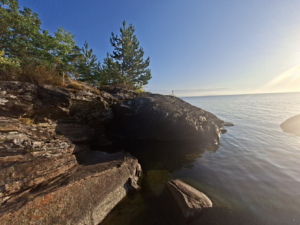
That time, I also took the trash bag from the campsite. We were closer to more developed infrastructure, so I was trying to find bins for waste segregation. It turned out to be not so easy because all bins were on private territory of detached houses. Slightly desperate, I decided to leave glass in someone’s private bin, and hid some fruit waste under a bush. Later, I found a communal segregation point, and engaged in the smelly business of taking one item of trash after the other to put them in different bins. I thought I was being exceptionally conscientious (a few days later I saw that others were also doing that, even under a thick drizzle).
An hour or so into biking, I decided to make rain preparations: got out a rain jacket, put my phone that I kept on the handlebar for navigation into a ziplock bag I had from buying black pepper, put my pannier bag, suspected of not being waterproof, into a plastic green raincoat, and my tent into a black trash bag. When I was finishing, first raindrops started falling. I was very proud of myself: I warned everyone of the danger and prepared myself for it. I had a white rain jacket and thin synthetic quick-dry pants on. I had rubber boots to change into once I arrived at the camp. What could go wrong?
The drizzle was soon over, and I was triumphant. The trip would be good, I believed, since I was prepared for one of the worst things I imagined — rain and cold. After a pause, I saw it raining on the road 100 meters ahead of me. I thought with a giggle,
«Maybe I can stop here, and it will just go away?»
But the rain ran to me and reached me in a couple of seconds. As I rode, I noticed that there was water under my sleeves. I thought,
«Maybe it’s sweat? Maybe it’s some water that was there before…»
Later, when I noticed more water on my skin,
«It’s okay, having wet arms is not that big of a deal. The important thing is that my torso is dry.»
«When I find some shelter or get to that library in Uddevalla, I’ll change my clothes. It’s okay.»
«Let the stoooormy cloud chase! Everyone from the place! Come on with the rain, I’ve a smiiile on my face! I walk down the lane! With a happy refrain! I’m singin’, I’m singin’ in the rain!»
Then, on the left turn after the Nordmannerröd on a busier road with trucks riding at full out-of-town speed in the air grey with rain, my vision limited by the sides of my hood, riding a bit uphill and needing to jump through a stream of vehicles passing, I felt that I would experience my journey’s baptism by fire (rain) that day. That I was experiencing it in fact. I managed to find a window of opportunity and jump into it, and rode on, with wet shoulders, arms, and back. Then, a turn right to a gravelly forest uphill road, then a turn left near Bjursjön lake. There I felt that my stomach was also wet, and my shoes were full of foot soup.
«Now it’s actually cold.»
I was looking for a place that could save me a bit earlier than the library. A toilet booth? But changing clothes involved unpacking everything and having bags open, so I needed a bigger space. An area under someone’s balcony? Too far. Someone’s porch? If I were braver and not afraid of people.
Right uphill turn on Helenedelsvägen street.
«Fuck me. Fuck me.»
And then, at Blekevägen 43, I saw my shelter: an open parking lot on the ground floor of the building, with the first storey making a roof for it. I went there without hesitation, even though I was already in the town, and the library was not that far away. First, I detached the luggage straps holding the light blue communal breakfast bag on top of everything. Then I unrolled both side pannier bags (also light blue) to get the dry clothes out. I also opened the black top pannier bag for the rubber boots. I took off my shoes, socks, pants, and underwear, dripping and covered in mud. Cars were passing by my naked ass, but that was a blissful moment, because I knew the worst was over.
Then I put on tomorrow’s underwear, leggings, and rubber boots, and changed the top part. Wringing wet sandy clothes left a puddle near the front wheel of my bike. Eating brought some more relief, but not enough — I lacked oil and protein, so a plan was formed to buy my own private peanut butter to never be in such a situation again.
Reborn, I went to buy some more food. Bananas and chocolate appeared in my hands in addition to peanut butter. Checking three water taps in the city brought me nothing, as did the dumpster-diving mission, a duty I remembered of with great sadness.
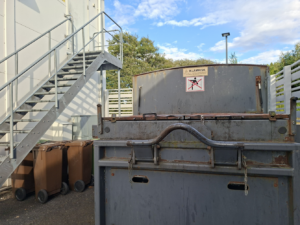
A steep rocky incline to get to the camp. Fortunately, I decided to leave the bike on top, and even managed to call for help so that it wouldn’t fall downhill, under the weight of all the heavy bags, now decorated by dirty rags spread around for drying.
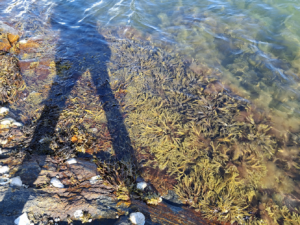
Swimming brought some relief, even though I cut my shin and toes, but this time the cuts were more shallow. The sea bottom had wide flat algae with egg-shaped nodes growing on it (bladderwrack), and I was observing their movements in fascination, because it seemed I had never seen such algae in the sea before. The stones were covered with big mother-of-pearl shells.
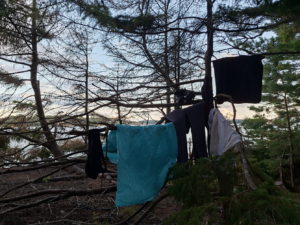
Then I moved my wet clothes onto spruce tree branches. I ate my dry, cold dinner of crisp bread, peanut butter, and bananas like my life depended on it.
I put up my tent between four trees that created a rectangle I could fit in. Outside that house, there were two stones, which were statues on my porch. A person came to my porch and asked me how I felt. I retold my story with painful details, and was listened to. Looking back at it was much more fun than living it.
I envied those who could eat a warm meal near the fire, but that is what I am getting used to with having to wait three hours after eating before lying down, managing the reflux disease. We shared our feelings during a circle (my first one because I go to sleep early), clapped on each other’s hands to finish it, and then played stone games on a stone.
Conclusions:
— A waterproof jacket might stop being waterproof in two hours of pouring rain. Shoes will be full of water, like two cups, and all tissue objects, including clothes, your fanny bag, envelopes, and stickers in them, will be wet. Consider waiting for some time under trees, covering yourself in plastic foil, wearing Crocs, and putting your stickers in a ziplock bag, not only your phone and passport(s).
— Have emergency food (like peanut butter) with you in case the lunch you took would be not satiating enough and/or you lost many calories, and you need more than usual.
— Embrace the thought that all you do to prepare for future dangers may not be enough, remembering that all things will pass.
18.08.2026 Rest day
Havstensfjordens naturreservat
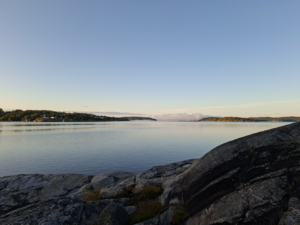
Strongly affected by yesterday’s rain, I was very happy to wake up to a sunny day. I knew from forecasts it was going to stay so, and that the following day would be rainy, and also a rest day, I thought. I was glad that I’d bike in good weather and stay in a place with a shelter in the rainy one.
However, when I was in the process of dismantling my tent, an Ecotopian asked me if I was into making that day a rest day instead of the next one because everyone was very excited about staying at the sea on that beautiful spot. I didn’t like the idea very much, but I wanted to see how strong everyone’s will was to stay. I went to the bonfire area near the sea. Beside it was a place with a huge stone elevated above the water, and some people were jumping from it to dive and swim. My fears were confirmed, and everybody indeed liked the idea of staying in the sun today and paying by riding in the rain tomorrow. I agreed to it, even though I was told several times that if I didn’t, people were okay with riding that day. I went to my tent to put it up again and cried, thinking in desperation that I am bad at protecting my interests. Fortunately, no one was walking nearby, and I could calm myself down and go on with the day.
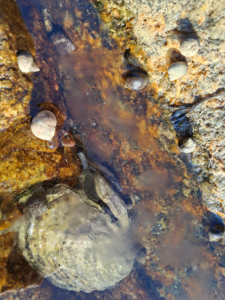
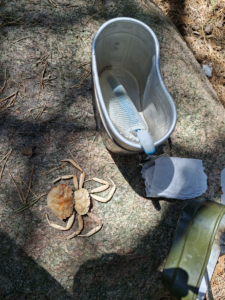
Then I was trying to see the advantages of staying — it was indeed a beautiful place, different from the lakes we camped at before. I saw jellyfish glimmering green on the edges (actually not jellyfish but comb jellies, Pleurobrachia pileus) and semi-transparent shrimps, moving quickly if they saw me move. I brought people to the spot where the creatures gathered. A person showed me a small purple starfish, which later hid between stones. Then I helped this person to get their phone from a narrow crack between big stones to thank for the starfish. I collected crab parts — there were so many of them scattered on stones, some with eyes, and some without. I found a niche in the vertical side of some huge stone and sat there comfortably like in an alcove, studying Polish. I moved my drying clothes on the spruce for them to be always exposed to the sun. I ate yesterday’s dinner for lunch — rice noodles cooked in sea water with peanut butter and vegetables.
We also had an opportunity to continue the river of a conversation on shoplifting. I shared my arguments, and later, a conclusion was made, which resulted in the creation of a comic book.
That evening, during the circle, I spoke about appreciating rest days — before I start them, I don’t anticipate how much I’ll enjoy them.
Conclusions:
— You are likely to return with more things than you brought, so have containers ready for things you might want to take with you (they might be fragile like a crab’s shell).
— Take the insoles out of your wet shoes for quicker drying.
19.08.2026 Arriving at Kärnsjön Lake near Munkedal
Herrestad — Munkedal
All my clothes dried, and I was happy to change into trainers. But my feet didn’t get to enjoy the dryness for long. When walking on the uneven terrain of huge multi-level stones, I was too confident and therefore inattentive to unpredictable puddles on the stone surface, deep enough for my right shoe to become wet again.
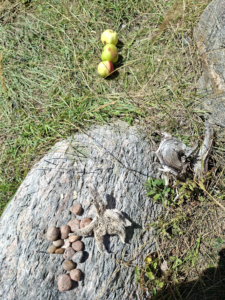
And later it rained anyway, despite the forecast saying there was a 30% chance of precipitation, not an 80% chance, like two days ago. It was not raining cats and dogs, though (nor orcas, nor badgers), but it was an assertive drizzle, and it started even before we left the camp. I left some crab parts on my porch stone because I collected too many of them. Then, as a carrier of the communal paper bag, I delivered goodbye letters to people who were to leave that day (but in the end left later).
A person who spoke to me about my distressing rain experience biked with me that day, and it was easier to get distracted from the wet and cold through talking on hopeful social narratives and choosing to be loyal to your ideas even when there is no hope. Moreover, after I cast my failure of a rain jacket to the bottom of a pannier, never to be trusted again, I chose my plastic raincoat as my new rain suit, which was actually doing its job. Then, during a stop in some cosy tunnel, I put more layers under the raincoat to get warmer. Soon we arrived in a town and rode to a library, which felt like a vestibule to heaven, so spacious, light, equipped with elevators, and visited by elderly people. We ate our lunches — my seawater noodles were accompanied by a tomato I retrieved from my pocket.
Then we moved to a dog cafe where the rest of the group gathered. In it, there were two more strangers, who also apparently arrived by bike and were drying and waiting for the rain to stop. Our crew occupied a whole room: many chairs were used as hangers for drying clothes, and sockets were occupied with many phones charging. The cafe keeper was very hospitable, providing us with towels, hot tea and coffee, tolerating us walking around barefoot and wet.
One person offered to play a pen-and-paper game with dice, which turned out to be quite challenging. I tried to also charge my bike light using other people’s chargers, but gradually others were leaving to go shopping, so chargers were also disappearing.
We decided to ride a shorter distance due to the general route recalculations; rain was a factor that made it easier to accept such a suggestion. I was a person who, maybe unwisely, assumed I could reach Oslo faster than the group, doing more kilometres on the last day, so such route recalculations were a stressful time for me.
On the way from the cafe, I found a reflective vest in a roadside ditch. It had some branding on it, so I though I could start a sewing project and put some patch on it, with the names of tour participants embroidered on it.
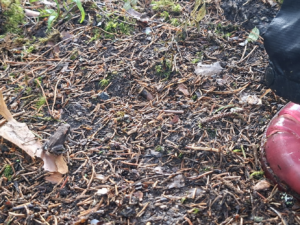
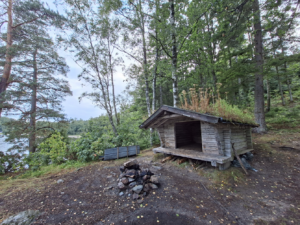
The final part of the way to the campsite was not easy, since it was a narrow hiking path going up and down steep hills, leading to a lean-to shelter, aka Love Shelter. We first explored it with a smaller group, and then, when others approved of it on the chat, went up to bring our bags from the bikes.
The place was swarming with little brown frogs — on the path, near the shelter, near the brown water of the lake. Everywhere. Some people argued they were small toads. One person was afraid of them, and they were assured,
«You can just sit in the shelter, and we will bring you everything you need!»
The shelter site was well equipped: there was dry wood underneath it, a grill grate, a sponge, a see-saw, and some reading materials on the walls. People used the grill grate to make pizzas from the dumpstered dough. I didn’t participate in cooking, but at least I could lend my leggings and a bike string to be used as a belt to a person in need.
Conclusions:
— Libraries save people.
— Consider having a charger with two ports to charge two devices at once.
— If the path looks too bad for a hiking path, maybe you’ve gone astray.
— If you have back problems, carrying heavy luggage can make it hurt at night, so consider carrying it in two stages or leaving some upstairs.
20.08.2026 Arriving at the sea, Kragenäs naturreservat
Munkedal — Tanumshede
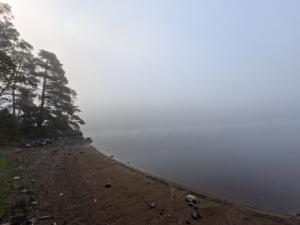
The lake was covered with a thick fog, and you could detect the location of geese flying only by their screams. As the sun was getting higher, the space became less milky, but not less dreamy.
The usual breakfast of oatmeal was diversified with bananas and peanut butter grilled in pizza dough. The dumpstered treasures also included almond chips, which I poured in my tupper generously. While busy in the kitchen area, I was reminded that my sleeping bag, which was drying from dew on a bush sitting under a sunny patch, was now accumulating raindrops from an occasional cloud. I thanked the person and hid my sleeping bag in the shelter, and they said,
«Before I used to hide other people’s things myself, but once a person protested, crying, ‘It was washing!’».
That day we had to say goodbye to two more people leaving our ranks. Now, there were seven of us left.
Going up with bags was tough. The intensity of my heartbeat made me anxious, which in turn increased the heartbeat even more. It was a wise decision to make a stop halfway to our bikes to catch our breaths. On the way, we saw a medium-sized toad. The toad knew how to share the forest and didn’t prevent us from going further because the path was their private property.
When we reached the bikes, another occasional cloud sprinkled us with water; we decisively told it «No!», and it didn’t last for a long time.
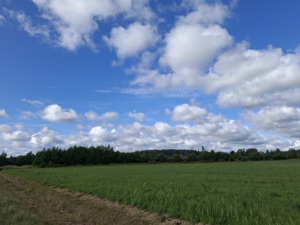
I had my shopping mission ahead of me, so I started collecting plastic bottles and cans to get a discount. It brought me a lot of joy, even though it slowed me down. I chose a spot for lunch that was further from the E6 motorway than the rest of the previous part of the route to eat my wonderful chickpeas and quinoa in tomato sauce with a piece of dumpstered vegan cheese on top. While eating, I saw fellow Ecotopians passing me, and waved to them. It was always a pleasure to meet your people on the way. Not only were people a source of curious information about their lives and environment — they also shed light on what was around us there, in Sweden.
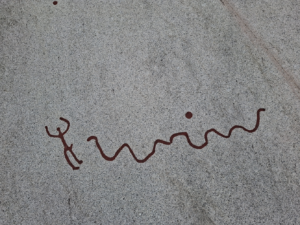
I was let know that we were approaching Bronze Age rock carvings in Tanum. I felt it was important enough to make a detour, even though I had a shopping mission ahead, and my low speed pushed me to make fewer stops and keep them very short.
When I saw the pictures, I cried. I felt like humanity gained another grain on the «for» pan of the scale of its existence, even though so often the «against» pan feels so much heavier.
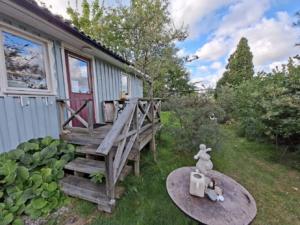
Entering into the town, I checked whether there were any farmer shops around, and found one. I went there, but even though the door was open and I could admire all the aronia and buckthorn jams, the shopkeeper was not there. Then I went into a supermarket, despite all our talks on how we should avoid that. My bottles and cans collected paid for my licorice package. I also happened to buy unplanned spices, which, although they occupied space, I later appreciated. My grocery plastic bag didn’t last for a long time, swaying on my handlebar, so thanks to the help of a biking comrade, we could rearrange our luggage and keep going.
«Riding downhill is great.»
«Let’s never ride uphill again.»
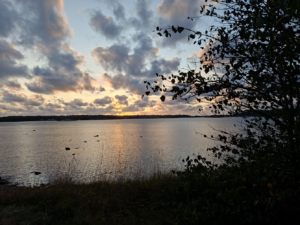
The camp location required no extra effort to reach, which felt unusual. The sea was very shallow for a long distance, so in the end I just had to lie down into the water, and then I crawled back to the shore using my hands.
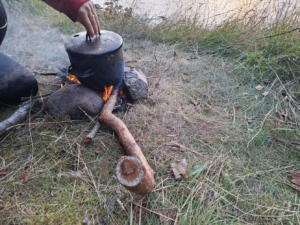
We cooked chilli sin carne with beans, corn, zucchini, chili flakes, chocolate, cinnamon, lime juice, cilantro, and tomato paste. Avocado accompanied the main dish.
Our group temporarily became smaller: one person decided to travel on their own for some time, and another person kept more to themself, and it felt more like it was five of us — because when planning cooking, I used that number for several days from then on.
Conclusions:
— A clothespin used to differentiate your left pannier bag from the right one may fall off, so find a discarded piece of light-blue rope on the roadside to perform its role (it can be also useful for tying up plastic bags with food).
— Handles of a plastic bag do get torn off by the weight of products for 10 portions of dinner and lunch.
— If you’re into cooking, consider bringing a small container of different spices, two or three spoonfuls of each, in a small ziplock bag, not to have a kilo or two worth of communal spices.
21.09 Arriving at the sea, Nötholmens Naturreservat, near Strömstad
Tanumshede — Strömstad
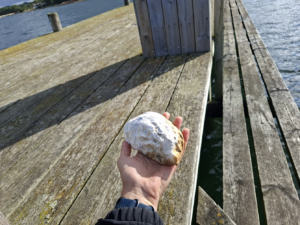
I collected some shells to bring with me, tempted by piles of them gathered on the beach. This morning’s yoga and meditation happened on a pier, and it felt like a luxury to be able to use a flat surface.
That morning, we also saw the birth of chocolate balls, a Swedish dessert made of oats, cocoa, sugar, salt, and margarine. We had an overabundance of different kinds of oats, so an idea of how to eat it faster came in handy. When we tried it, I knew I would cook more.
After breakfast, the introducer of a new dessert organised a free shop basket because they said they «had too many things». This way, I became the owner of a black baseball cap, another reflective vest (but occupying much less space), and a portable water container. I got an insight into how I can also try to get rid of a couple of items I realised I didn’t need.
The day was to be sunny, so I dared to take the dumpster diving duty the second time, while the first one after a rainy day was a nasty burden. I went into bottle collecting mode again, but that day’s route was shorter and cleaner, so in Strömstad I decided to dumpster not only for food, but for bottles also. In the end, it was the only resource I found. In a room with recycling machines, I discovered a new character: a machine where you could pour the whole bag of bottles, and it spat out those it didn’t want to take (I gave them a second chance, and some of them stayed in) and a receipt. The room, like other rooms of the type, was equipped with a sink with a tap, unlike in Poland, and washing hands in running water during Ecotopia is a sweet and delicate treat. And even a bigger treat is just going through the day without rain. The trash bins might be empty or filled with actual junk, the roads might go up, but everything feels soothing and uplifting when seen in the sun.
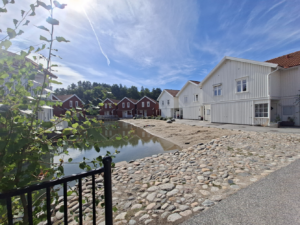
I used my newly acquired water cube to bring some water from a tap to the camp, attaching it to the handlebar using the light-blue plastic rope found on the roadside (of course, after trying to hold the container with my hand and feeling how my tissues are mechanically not suitable for carrying that weight). Then I passed a very fancy district of the town, with doors of houses opening to small beaches where you would expect to see a garden or a playground, and boats on water, where you would expect to see a road with cars.
The walk to the campsite was strenuous. I had to push my bike up through a forest growing on rocks covered in moss and heather. When I saw two Ecotopians returning from the campsite to go on a laundry mission, my water cube started falling to the ground because the rope was not mechanically suitable for that weight either. I assisted it in its descent, collected some detached light-blue strands from the stone surface, and realised that the rope was not to be trusted.
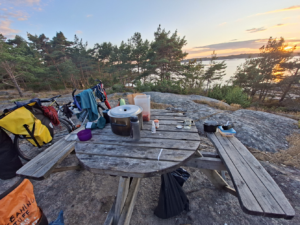
The campsite was our reward. We were high up and could enjoy the view of the sea and islets around. The shelter had a compartment with firewood and two benches; near it stood a large, sturdy fire pit table with a grate and a side lid, where cutlery and spices could be kept. A bit further away was a wooden table, a bit unstable, with four benches, where it was convenient to clean and cut vegetables. I think I enjoyed those tables more than anyone because my back could be kept straight and free of pain while I cooked, and the food was not in the same area as my shoes were.
That evening I chose to cook, and since we had dumpstered potatoes from yesterday and lentils from farmers from the days before I joined the tour, I decided to cook lazy vegan Shepherd’s pie. It needs potatoes, celery stalks, carrots, onions, garlic, tomato paste, herbs (I finished the basil we had), oil, pepper, and salt. Then I moved to cooking a dessert — Nutella with pears. Nutella required mixing peanut butter, sugar, cocoa, water, and salt. Then, pieces of cut pear were to be submerged into the paste and consumed. The feast mood was so permeating that even a mouse ran up to our table and we tried to share some oats with them.
Busy with cooking, I was free to put up my tent only in the twilight. I was looking for a flat area with my red bike light because I could attach it to the strings of my hoody. The first one I found I later rejected, and when I found something flat, I made the decision quite quickly because the search lasted longer than usual. Again, I had a stone at my porch I could use as a shelf for keeping things on it. But that time, my floor was pure stone, not stone with some grass and dirt on it, so I didn’t use any tent stakes.
At night, after midnight, I was woken up by thunder. Soon, rain followed. At first, I thought I should run out to hide my towel drying on the handlebar, but then I realised that the cost of that move would be getting wet myself and having to return wet into the tent, so I decided to stay inside. I went to sleep, happy that I had a roof above my head, and admiring the courage of those who slept without one (and were able to see a fox due to that).
Conclusions:
— Headlamps can be useful.
22.09 Rest day
Nötholmens Naturreservat
However, the flatness is not the only desirable quality for a tent spot, as it turned out to be. I woke up to find some of my clothes lying beside my mat wet. I inspected the roof and walls, but to no avail — there were no signs of leakage. I evacuated my belongings to dry the tent floor with my red fleece jacket that got wet initially. Then I realised that the water came from below, through a small puncture in the tent bottom, while my tent was standing on a puddle. That day involved a lot of drying management.
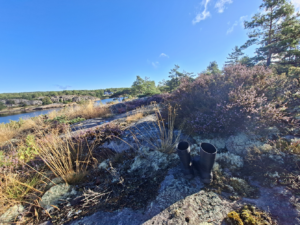
That day, I inspected the tail bag with bike tools and parts, while enjoying a conversation on relationships in our families with a person from our group. Initially, I was looking for some lube for my chains. Even though I found none, I still could play with grouping different tools according to their type and binding them together with rubber bands, which were also, to the surprise of my interlocutor and me, present in the tail bag.
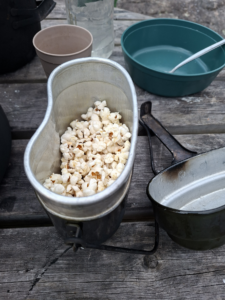
In the evening, I cooked popcorn in a smaller pot, while the large one was occupied with chickpeas and carrots smelling dizzyingly of cumin. I added agave syrup and salt to the popcorn, but one person said it was too salty for them, so I promised them to make the second batch without it. I ate almost the whole pot, happy that I could eat so much, and of such a sweet and fatty food, and that it was very justified by my energy losses. The second batch was smaller and cooked in my canteen, since the smaller pot was necessary for cooking something else. The grate of the fire pit was fully packed with our cooking gear, and some other people who wanted to fry their sausages had to wait a bit. I was throwing in more wood for the fire to reach all the spots, savouring its power.
I announced my own free shop that time, which travelled from a table bench to the shelter bench later. Also, I announced a rain which didn’t happen, but it prompted me to make some rearrangements in the location of my belongings to prepare for the ever-present danger. I put up my tent in a different place, on a grassy patch near the sea. But only then I asked a person who had tented there the night before for a feedback, heard it was damp there, and removed my tent to a more elevated area more distant from the water.
Already after sunset, I asked one Ecotopian for their private bike lube, and oiled my chains, wiping the excess lube with pieces of newspaper found in the firewood compartment. I did it without fabric gloves, although I had them, because it would take time to go fetch them from my tent, and like on many occasions I chose to bypass the longer and wiser route.
Conclusions:
— When putting up a tent on bare rocks, avoid areas where a puddle can form under the tent in case it rains, even if the weather forecast says it won’t.
— Bringing rubber bands is a good idea, even if you find some more of them hidden in the tail bag.
— Use fabric gloves when dealing with bike chains and not having access to running water, or your hands will remain black for a week.
23.09 Arriving at Isesjøen Lake near Sarpsborg
Strömstad — Sarpsborg
My attempt at free shop succeeded, and I passed the first reflective vest I found in the ditch to another person. I finished my home-made Nutella for breakfast and discovered I actually like margarine: with crispbread below it and raspberry jam above.
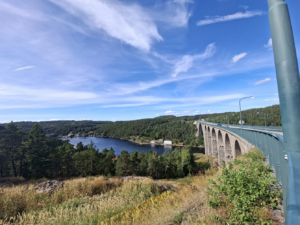
That day we were to cross to Norway. I worried that after the bridge crossing, my health insurance or my ID’s might be checked, that my roaming wouldn’t work, that prices would be too painful to see, but none of that happened. Instead of inspections and financial losses, Norway welcomed me with a pleasant surprise at a gas station cafe near our next campsite. I left my bike and all the stuff outside, unlocked, and entered with my water cube hidden in a black plastic bag, intending to get some water for the group. But oh boy, did I receive more than water. The bathroom had a toilet, a sink with a mirror, and a shower booth. No, it was not mouldy, gross, covered in junk, nor cobwebs with spiders, nor badgers, nor orcas. It was a perfectly decent shower booth. I quickly undressed and went in, finding a tick crawling on my left wrist and washing it off before it could bite. I used my hoody as a towel, since I was wearing it around my waist because it was too hot to have it on. From then on, I wanted more of that, instead of hiding behind boulders, partly undressed for washing, from people walking their dogs in nature reserves. Thus, the swimming season was officially closed.
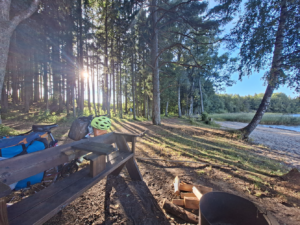
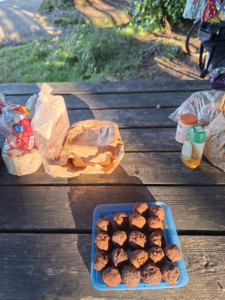
There was a table at the campsite, and I had one more wonderful evening of cooking with my back straight. I cooked more chocolate balls because I had the breakfast bag and didn’t need to wait for more people to come to get to their share of communal bags. Then we cooked dal: red lentils, onions, dumpstered bell peppers, 1,5 cans of coconut milk (0,5 left for breakfast), tofu, cumin, cinnamon, chilli flakes, ginger (the thing we carried for a long time and which was the reason I chose that dish), oil, and salt. People were eating dal with grilled bread, since we had a lot of dumpstered buns, and a small pot of rice was cooked for those who avoided bread. As always, we were encouraging each other to eat MORE.
The evening circle stressed me out, since there was another route change request, which would make my arrival in Oslo on August 26 by bike problematic. I juggled scenarios in my head: parting with the group on the 25th to make more kilometers and sleeping alone? Departing at 4 am on the 26th heroically? All of that sounded bad because I knew from practice that rain’s plans for things are far more potent than mine. I was assured there was a good train connection to Oslo, but I was afraid I wouldn’t be able to reserve a place for my bike, which was recommended at that part of our route. I said I would need to sleep on that, and we could return to the subject in the morning.
Conclusions:
— Sometimes gas station cafes can have a shower booth (new and clean).
24.09 Arriving at the sea near Vikane
Sarpsborg — Fredrikstad — Vikane
The remaining half of a coconut milk can was indeed used to cook sweet rice; three portions for three people interested in it. The rice was supplemented with dumpstered mangoes and pears. Now, it reminded me of the sweet rice breakfast during Ecotopia two years ago, in Latvia, but for colour it had lingonberries.
Some children saw us and addressed us in Norwegian. Then, in English, they asked where we were from, and told us about themselves. I was not in a talking mood, so I went on with my bike, to later take off most of my morning layers of clothes at some playground to adapt from the 6–8 am cold to 10–11 am warmth.
That time, I took a warm shower at the same gas station cafe more confidently, going in with a shampoo bar and a towel. I had to wait for the cafe to open for that, but that gave me time to make notes, so that this lengthy blog post could appear later.
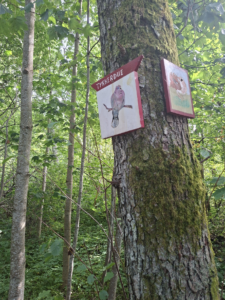
While shopping in Fredrikstad, I fulfilled my plan to develop the chocolate balls even further and bought rum aroma, together with coconut chips and almonds. After I finished, I joined an Ecotopian while they were feeding pigeons at a square with yesterday’s dal, telling me it was a good spot for catching them, and that they know it from an experience of saving pigeons from human hair wrapped around their fingers and causing necrosis.
The last obstacle course on the way to the campsite was demanding as never before. Not only was it steep and gravelly, with a lot of pushing the bike up and riding down while braking, but I also made it harder by tying a full water cube on my handlebar (that time with a roadside piece of rubber). The container was swinging and making it even harder to keep my balance. My bike fell only once, and not during my ride — it did so when I parted with the person from our group, who chose a longer but less steep way, and with the old ladies who helped us with finding water and pushing bikes at the beginning of the obstacle course, on its steepest part. I just walked, and the uneven incline of the path surface made my bike gently but surely lie down on its right side for a rest, trapping my feet and hands. The water cube had a small hole in it, and I was trying to keep it vertical and free of pressure from the handlebar so that it would not lose water, and the handlebar was fighting back. A couple of minutes later, I resumed my walk. Together we stand, divided we fall.
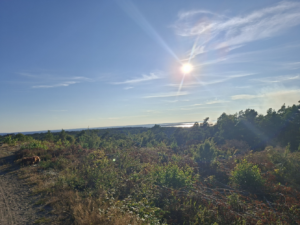
After a stunning view from above, with sea and islands visible in the long distance from high above, the view from down at the campsite was somewhat underwhelming. Maybe I was influenced by the judgement of the person responsible for dumpstering that day, who resolutely brought a huge basket of vegetables and fruit from Sarpsborg — there was so much that the kickstand of their bike broke — and their exhaustion by the way was even more prominent. But their effort brought us abundance: avocados, a tangerine, mangoes, kiwis, pears, strawberries, nectarines, dried figs, tomatoes, potatoes, asparagus, green onion, and a cucumber. So I jumped at all of the fruit and made myself a salad, consuming it aggressively after the day’s trials.
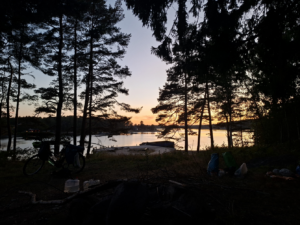
Old ladies who helped to push the bikes reappeared in our sight to inform us that setting open fires is prohibited at that time of year in Norway. After distinguishing a starting fire, we discussed whether we should obey. After considering a helicopter hovering above the other shore and smoke coming from the forest there, and also the embarrassment we’d feel if the old ladies saw us setting the fire again, we chose a colder dinner. We cooked the potatoes on gas, but black beans with vegetables, which was the main volume of food, were of room temperature.
The night sky was clear, and the Moon was full, travelling sneakily from behind a spruce tree, then onto its branches and then into the vastness of black space.
Conclusions:
— You might hear a prohibition on starting a fire, so be ready to cook a cold meal and/or have some emergency gas bottle with you.
— Make statements about what you do and do not have space for.
— Asking people for help may result in even more help than you expected.
25.09 Arriving at the sea near Moss, Reierskogen Naturreservat
Vikane — Moss
It was exceptionally cold for me in the morning. I picked a spot for sitting where I expected the sunlight to appear first and waited there, on a pier, near an abandoned boat with rusty trash loaded on it. Together with me were schools of fish, waiting closer to the surface, with individualistic big fish swimming near the bottom.
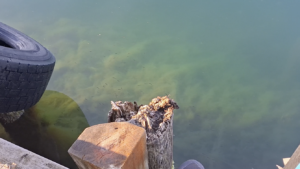
Gradually, light was bringing relief. Then, breakfast brought delight — one person cooked compote from strawberries and apples we all gathered on the way. Delicate pink chunks of apples were definitely in a different league than sweet homogenous jams we always bought from shops.
That day I chose packing and organising as my rota duty. Having found the rubber bands and having organised a bag with bags near Strömstad, I was ready for this role. We had a lot of extra volumes, so some food went into private panniers. Pouring out some unused water from my cube was more painful than usual because I remembered how much it cost to get it there.
We compared our experiences of the routes here because different people chose different paths. All insisted on their path being shittier, so at least several people, including me, chose the unknown shittiness instead of the tried one. My new path toppled my bike in a couple of minutes, but also only once, so we can assume it was just as bad. That happened on a part that reminded me of the bottom of a fast mountain river, with no flat surfaces, which made it hard to move further because the bike wheels kept sliding to the left or right. After one of many slow, short, effortful pushes up, the bike fell into the ditch, and all the luggage fell from it also. First I attempted to get them out together. I laughed at how fullish that attempt was, while everything was falling again. Then I picked my bike and carried it up to pass the steepest part. Then I returned for my bags to bring them up also, and realised that they are much heavier that the bike on its own. No wonder it happened, I thought.
Then I spent several minutes mounting the luggage again, and then, surprisingly, I could ride. At some point I passed the person who cooked compote. They were walking with their bike, a sight I had not seen before on the road, but I was too preoccupied with my own ascent experience, so I cheerfully told them about it and went on.
I made a detour to visit another gas station cafe. It opened even later than the previous one, at 1 pm, so I again took out my small notebook to describe several more days, not managing to write everything again. The cafe keeper didn’t talk English, so at first I interpreted their reaction as a prohibition to use the cafe’s bathroom for free, but then they handed me a key and showed using gestures, that the entrance to the bathroom is actually outside, not inside. That time, there was no shower, just a sink and a toilet, but I still enjoyed a) human kindness, b) running water, and c) a closed space where no one saw me.
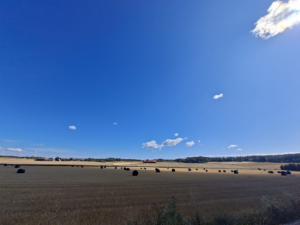
Later, I met another person from the tour, and they let me know that the first person’s wheel rim exploded. I helped them with communication since their phone battery was dying, then took out a tick from my left hand, and afterwards, we had lunch under an apple tree near some house. That time, there were so many nuts, fresh and dry fruit for dessert, that I exclaimed,
«That’s how it should be!»
When we were finishing, the owner of the house, apparently, drove past and smiled at us.
We rode on together, avoiding road dangers of fast cars moving near you, and trying to solve the problem of water in our bottles running short. Then I wanted to part to arrive earlier and to start cooking earlier, but my companion had no water, no charge on the phone, and a barely working charger that was dying in front of my eyes. I assisted them in their plan of acquiring a new charger and went on.
The further way had rises and falls as usual, distinguishing itself maybe with the fact that I had to push up on asphalt in a town, not on gravel in a forest. I was tired from all those pushes and was glad that I was in the city where I would sit on the train.
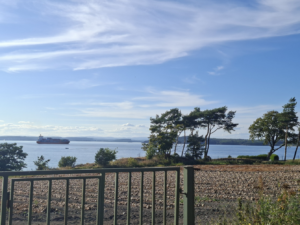
I reached the campsite to find just one person there. We needed room for a conversation, and luckily we had one, because others were waiting not so far away at a competing campsite. When we finished talking, the rest started arriving at our spot.
I started preparing for cooking when it was already getting dark, but the wall of stones near the bonfire was very warm, and I could lean against it affectionately. It was not easy to operate the ball-making procedure without a table, especially since that time I added almonds roasted on fire to the center of the balls, and made two versions of them — one with rum aroma, and one with coconut chips. They fit well into margarine containers freed by cooking the dessert. I also freed a plastic bag with oats, which was now full only of potential to contain other food.
Two people travelling more on their own arrived, and we were seven again, for an evening, a night, and a morning. The Moon was again making the site nice to walk around, because you could see where you stepped even without a flashlight.
Conclusions:
— When planning to wash your hands and/or dishes in the sea in the darkness, consider using a flashlight to see if you want this particular water to touch your mouth.
26.09 Departing to Oslo
Moss — Oslo — Ystad
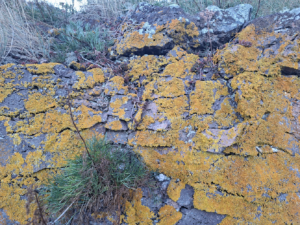
People were finishing my goodbye postcard. They threw glances at me, thinking what to tell me in writing, and making drawings. I looked at my watch very often, to make sure I had time for troubles happening on the way to the railway station. From the person with the exploded rim I found out that it took them 45 minutes to walk to the camp site from the station, so I had proven numbers. I also knew there were free showers in the city, so I also counted to have enough time for that.
I planned to take some spices with me, because there were way too many chilli flakes and nutmeg for about five more days of travel, but I didn’t have enough intact small plastic bags, only holey ones. But I managed to leave some fire-started privatised by me on the first morning of my trip there. I found a paper bag for them, wrote «firestarters» on it and drew a small cube for fun.
«WE DO IT FOR FUN».
We hugged goodbye. Some hugs were accompanied by good wishes, and some were silent. I went to my bike, and, smiling, said that it felt weirdly easy to move it, now free of the communal bags.
Outside of the forest, I rode to a big waste segregation site to get rid of some trash I had in my pockets for days. Knowing that my trip was about to be over made me feel bittersweet loss while parting with all the little things. Goodbye, a piece of dental floss, a receipt, a piece of light-blue rope strand; I was nice knowing you. Goodbye, a free clean concrete shower booth with cold water on a beach. Goodbye, the bright sunlight reflecting from the shower booth floor, illuminating the water spray pushed out at high velocity together with air; thank you for making everything look beautiful. Goodbye, passersby; thank you for not stealing my luggage and bike, left unattended and unlocked for so many occasions.
I had enough time to calmly ride to the station, charge my phone there a bit and let the towel dry on the handlebar. On the way to Oslo, I checked how I could use the little time I had there, and in the end, I chose a botanical garden: it had a section with an Aromatic Garden (Dufthagen) and Redlisted and Blacklisted Plants Garden (Rød- og svartlistebedet), and it was quite close and intriguing. The first section had bushes of plants used for cooking, like rosemary, basil, melissa, mint, and many more. I smelled all of them, sharing my fascination with bees.
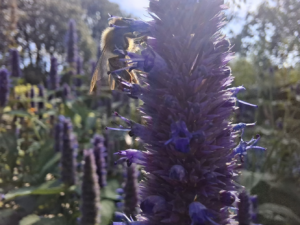
In the other section, I managed to eat my lunch: potatoes cooked in oatmilk, sprinkled with nutmeg, a bean salad with corn, and figs with peanut butter for dessert. Then, for a hundredth time, I looked at my watch, happy that I was on time.
The road to the railway station stressed me out, because first I tried to enter it from the ground level, while it had to be done via a bridge. Luckily, I remembered the departure time a bit wrong, and it left me with a longer safety margin. I entered the train, plugged my phone in to finish charging, and was relieved with a new degree of certainty. I was going home.
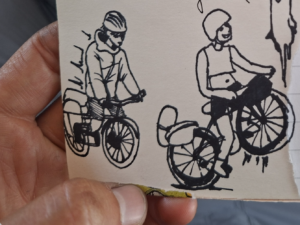
Conclusions:
— Railway stations can be as complex as airports; consider adding 15 minutes to your usual safety margin of arrival before the train when coming to new cities.
— Sleeping on the floor on a ferry instead of a reclining seat is doable and objectively better.
— A desire to preach Ecotopia to unsuspecting people intensifies after a tour.