


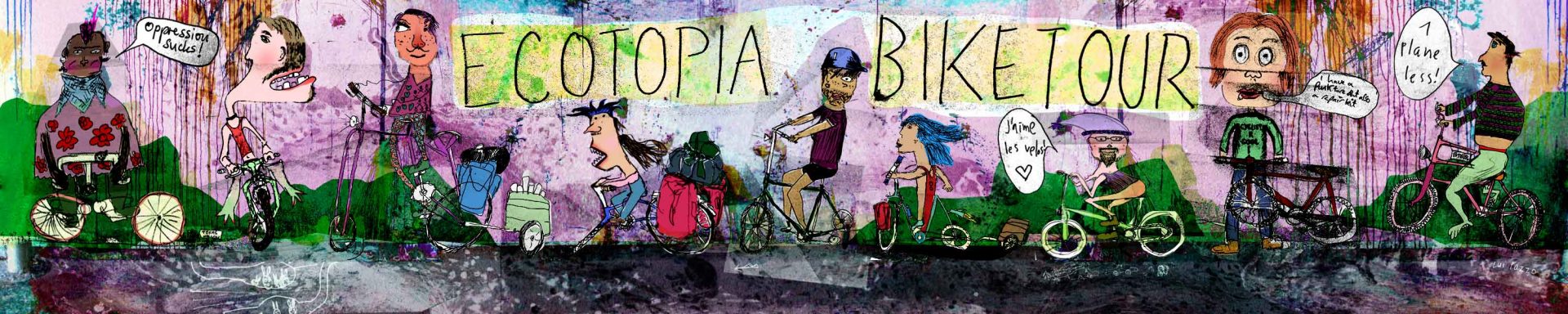
The Childish Weeks are over and I think they were a huge success! 1 toddler, 10 children and 1 teenager participated, along with around 20 adults. While everything went well, there were some challenges and some things that should be improved next time. The weeks were prepared well, but not necessarily prepared right. In this blog post I want to reflect how I experienced the weeks as a parent with a toddler, but also as an organizer, and what we could do better next time. I hope that some other participants with different perspectives will publish their reflections as well.
I joined the tour one day before the Childish Weeks. Before, we had cycled for a few days through Sweden alone. This means that when I joined, I had already built up a bit of strength, a routine of cycling and camping together, and I was self-sufficient with my equipment, meaning that I had all the tools and devices that I needed and was not dependent on the group. I also have a lot of experience travelling by bike alone and on the Ecotopia Biketour, meaning I had a good idea of what to expect and was prepared for it. All these factors made it easier for me to join, and someone joining with a toddler but different prerequisites would have had a totally different experience.
Route and distances
We had had a few exchanges with the parents throughout the year planning the Biketour and had collected our thoughts in Childish Weeks Guidelines. We came to the conclusion that 35 km would be a good daily distance both for children cycling themselves as well as for caregivers pulling their children (trailer/seat). Rest days wouldn’t be important for children and our regular rule of 1 rest day per 3 cycling days would be sufficient. However, to be safe, the route was planned with only 20 km daily distances and 1 rest day per 2 cycling days.
It turns out that our estimation was way off and it was good that the route was planned with smaller distances than what we had come up with. Physical exhaustion was not even that much of an issue, but the motivation was a huge limiting factor for the children. In the first days they were struggling a lot. On the one hand, there was nothing motivating them to go, and on the other hand, there was a lot motivating them to stop (interesting things on the side of the road, for example berries). Throughout the weeks, we developed the following new criteria for the road:
- 15 km should be the maximum daily distance. A little bit more is possible if the way is flat and easy.
- We should exclusively use ways without car traffic, so cyclepaths or very rural roads. Parents are stressed when there are cars, and children are told to cycle properly. They cannot stop spontaneously in the middle of the road when there is something interesting to see. This makes the way much less enjoyable for the children. Cyclepaths along busy roads are possible, but without cars the ride is nicer.
- The campsites need to be especially beautiful and interesting so that the children look forward to them and have a good time there.
- The first days, the distances should be even shorter, because the children don’t know yet what to expect and thus have no motivation to reach the campsite. Over time, they will learn that it’s worth to arrive at the next nice place and will have more motivation to go on.
- Motivational activities should happen along the way. For example, treasures with sweets, tattoos, toys or other little presents can be hidden along the way and announced in advance. This greatly helped kids to have a nice time on the way.
- One rest day for every two cycling days is a good rhythm.
It seems like these criteria greatly limit the regions where the Childish Weeks could happen at all. Sweden seemed like a very suitable place. It is easy to find a beautiful and legal campsite on a lake every 15 km, and there are good bike paths in some places. A challenge was the very hilly terrain.
In many regions, finding suitable campsites would probably be a big challenge with daily distances so low and a very little margin to make the route longer to reach a suitable campsite.
Finding good ways was even difficult in Sweden. We did not know in advance how much of an issue car traffic would be, and we also didn’t expect that many of the roads that looked very rural on the map turned out to have a lot of car traffic.
It should also be noted that these criteria are based on children cycling themselves, and some of them contradict the needs of the caregivers of toddlers that are being pulled. Too short daily distances and too many rest days can lead to boredom among toddlers, which can be very stressful. For me, the rest days were more exhausting than the cycling days, because the activities did not come by themselves, but I had to create them. The group can help to compensate this through other forms of child entertainment. In addition, taking very rural ways often means not passing a lot of infrastructure. Toddlers often need supplies, for example diapers, from shops. We had set as a guideline to pass shops every 2 days, but we didn’t achieve this. Rural roads also tend to have steeper and more inclines and worse quality. People pulling toddlers and their luggage have an exceptional weight to carry, so are especially affected by the hills and road surface.
The best for the future would be to prepare the exact route for the Childish Weeks in advance. This way there would be no unexpected surprises on the way. Infrastructure (shops, train stations) and activities (playgrounds) can be researched in advance, as this is more challenging on the way, and it enables caregivers of toddlers to at least know when to expect the next shop, so that they can make sure to have supplies until then.
If the Biketour happens in a region where following these route criteria seems unrealistic, we could consider organizing the Childish Weeks as a separate biketour in a different place. However, this would also have many disadvantages, such as requiring duplicate equipment and not having many adults without children there, which would make life for the group more challenging, create less opportunities for the children to bond, but also be a missed opportunity for those adults to bond with children.
Another thing that came up was that many adults without children were also happy about the short distances. Organizing a whole Biketour with such small distances is probably not feasible, as it would mean not getting very far and thus also not visiting many places on the way, and some people also struggle with the short distances due to boredom or deterioration of their fitness. But we should still discuss whether we cannot take the concept further and for example organize a Slow Month instead of or in addition to the Childish Weeks.
Language
Language played a huge role in the social dynamics of the children. Even though some of the children could already communicate surprisingly well in English, it was noticeable that they were a bit shy about it.
It was very visible that children interacted mostly with other children or adults who spoke their language, at least in the first days. Later in the Childish Weeks children who could communicate even just a little bit in English started to speak and interact with each other more and more. It seems to me that it was a great learning experience for them to successfully communicate with people who speak other languages. But clearly it was essential for an enjoyable tour that other people speaking the same language are there. I don’t know if there is anything that we can do to address this.
Relationships and bonds
Some of the children who spoke the same language became friends in the first minute. For others it took a bit longer, but I had the feeling that the children generally benefited from other children being there. The children also formed bonds with many adults and vice versa.
For my toddler the presence of other children did not seem to play much of a role, but the interactions with some of the adults were very important experiences for him. Before the Biketour, he would usually be afraid of unknown adults and try to hide from them at first. In the Biketour community in general, he did not seem afraid, and in particular, he seemed to form relationships and trust with several of the adults in the group. A development became very visible after a few days and he started to play or interact with specific adults a lot and did not even need me around in those moments anymore.
The bonds with adults grew continuously throughout the Childish Weeks, and I feel it was very beneficial for this that we stayed for the whole 2 weeks. Towards the end the other direction of the bonds started to become apparent as well: I got the feeling that several adults started to actually feel emotionally close to my child as well, and I think it was an enriching experience for them as well. While in the beginning, it seemed like childcare felt like work for many, towards the end it started to feel more like a fun activity. My impression was that for some adults who hadn’t had much contact with children before and maybe perceived raising children mostly as a burden, the Childish Weeks showed them what joy it can also be to have children around. In addition, I think that the Childish Weeks also awakened the inner child in many adults.
Unrelated to the group and the Childish Weeks, I cannot stress enough what an exceptional experience it was for my child and me to travel by bicycle and how incredibly it has strengthened the bond between us. Travelling with a toddler of 2 years of age was a challenge, but I felt like for the development of the toddler it was exactly the right time to start with this. The Childish Weeks are a great opportunity to start biketouring with children in a supportive environment.
Communication and decision making
In the first days of the Childish Weeks, I sometimes felt like I was joining a Biketour of adults that did not care about the needs of parents and children. It seemed like almost no one had read the Childish Weeks Guidelines. A lot of energy was put into entertaining and including the older children, but that was not useful for my specific situation. Only two circles (meetings) happened during the first week, and the first one was not accessible for me because it happened in a very tight space where my toddler could not move or play, and the second one was not accessible because it was announced very spontaneously and happened during the time when my child needed to be brought to bed. I felt like I had no place to communicate with the group about my needs, and decisions affecting me were being taken somewhere without the possibility for me to be involved.
My impression is that it was much easier for people to imagine and understand the needs of older children than the needs of babies/toddlers and their caregivers. One reason might be that we still remember what we liked as children, and children tend to give feedback in a clearer way. Also, toddlers and their specific needs seem to differ much more from one another. We had tried to raise awareness of many of the potential specific needs of toddlers through the Guidelines, but this failed.
With the experiences of the Childish Weeks, I now tend towards thinking that the needs of toddlers and their caregivers are just too unique and a written document is just too abstract. We cannot prepare the group for those needs in this way. Instead, we have to work on the communication and decision making procedures. By creating regular meetings or other ways of communication from the start, we make sure to have a place where we can talk and exchange our needs. This way the individual and unique problems can be solved when they come up.
For the participants of the tour, the start of the Childish Weeks was also a challenging time. Many of the participants left in the days before the Weeks, so the same number of tasks had to be done by far fewer people. Then the children arrived, when the group had had no time but also no idea how to prepare for them.
I think for the future, it would be useful to provide a Childish Weeks Preparation Guide that explains how to prepare for the Childish Weeks, rather than how to deal with the children. It could contain something like this:
- Have a circle on the first day of the Childish Weeks. Have it in an open space where children can move around. Assign some people to childcare (ideas: crafting corner, toys) so that the parents can fully attend. Still some parents might not be able to attend; ask them for their input beforehand and summarize the decisions to them afterwards.
- In the circle, talk about needs regarding the route and regarding food times. Based on food times, fix an arrival time for the food and cooking equipment. Set up a schedule of regular circles (every day?).
- Get things to hide as treasures on the way (sweets, tattoos, toys) and to use for activities at camp (crafting corner).
- Assign people to hide the treasures and to facilitate the activities.
- Read a document together that introduces some of the needs of children (like the Childish Weeks Guidelines, but shorter), for example unobvious dangers (swallowing batteries/magnets, silent drowning, falling bikes), no photos of children, camp far from toddlers if you want silence at night.
The group could work through this guide in the days before the Childish Weeks start. This would ensure that children and their caregivers would feel welcome and have the infrastructure to express their needs from the start.
In the second week, we had daily circles and talked a lot about the needs of the children and their caregivers. Many things still did not go as planned, but the feeling when something went wrong was completely different. In the first week it sometimes felt like people just didn’t care, but in the second week I knew that they were aware of my needs and tried their best, and if it went wrong it just meant there were unforeseen circumstances like there always are on the Biketour.
The short daily distances of the Childish Weeks allowed to have daily circles, which are impossible otherwise because the daily rhythms of different people vary so much that the first people have started cycling before the last people have woken up, and the last people arrive after the first people have become too tired for a meeting. We alternated between a morning and an evening circle. Having daily circles had a really strong positive impact on the group dynamics.
Dangers
In the Childish Weeks Guidelines, we listed a lot of potential dangers and worries. For example, we were completely sure that there would be at least one serious accident with a child pulling on a bike and the bike falling on them, considering that even without children, bikes are falling over with their luggage all the time.
It seems now that none of the worries were justified. Almost no one read the Childish Weeks Guidelines, and sometimes it seemed like with each campsite we were trying to tick another item off the list of potential dangers (we even had one with dangerous holes). But nothing ever happened. The older children are already aware of the dangers, and in this environment and lifestyle where everything is more simple, the dangers are also just much more obvious. The younger children were usually staying close to their caregivers or other adults, and the camps were spread out enough that they would never get near the dangers in this way. Of course I am not sure whether this would have been different if there had been more toddlers.
It seems like the list of dangers can be greatly reduced and does not need to be compulsory to read for everyone in the future. Instead, it can be available as an interesting document somewhere for those who have no experience with children.
Food
In the Guidelines for participants we wrote: “be aware that children need food more frequently, more reliably and in a more predictable schedule. Dinner should be ready at 18:00 the latest.” For caregivers we wrote: “While the whole group is asked to especially take care of preparing good food reliably, on time and in large enough quantities during the Childish Weeks, be aware that the Biketour has a tendency to finish cooking too late, in too small quantities and that the food might taste bland. It is probably best if you carry some backup food for your children with you.”
While in the end no one joined with a requirement to have dinner already at 18:00, I quickly noticed that 20:30 is a good limit for me so that there is time to eat before going to bed around sunset at 21:30. A few times we waited for a later dinner, and my toddler was very unhappy after that and took forever to fall asleep. I think dinner was ready by 20:30 maybe on a quarter of the days. Even when we explicitly set the time limit for dinner to 19:00 in the second week, some things kept going wrong every day and we rarely made that time. Knowing how things go on the Biketour, I had made sure to always carry enough food with me that would last for dinners until the next shop. I think it was a good recommendation to carry enough backup food, and we should keep recommending it in the future.
There is another dimension to food that I only realized on the tour. As an only parent of a toddler, there is a specifically high requirement for me to be available for my child, higher than for multiple parents joining with a toddler (they can take turns) or for parents joining with older children (the children are less dependent). Biketour food has an increased risk of causing stomach problems and even food poisoning. It usually happens to several people each year. Having food poisoning alone is a pain, but having it with a toddler being dependent on you is a disaster. This means that having a toddler with me actually affects what kind of food I can eat, as I need to be extra safe to be available at all times.
While I was fortunately spared from food poisoning with diarrhea, vomiting and complete weakness this time, I did have diarrhea for a few days where I needed to urgently and unexpectedly go to the toilet several times a day. This is even a totally different story on the Biketour than when travelling alone with a child, because the camp is large, you need to find a spot far away from it, and someone else might already be there, so the way there is very long, while at the same time your child might want to stay back with the people at the camp but also does not want you to leave. This was a very stressful experience for me.
I strongly suspect that the biggest cause of food poisoning on the Biketour is spoiled food from the day before. Nowadays we usually cook more than needed for dinner and people take the leftovers in their tupperwares to eat as lunch the next day (at least this means that there is always enough food for dinner). For some reason, the food that we cook tends to spoil very fast, even in the cold temperatures of Sweden. I think my recommendation to parents, especially for only parents of toddlers, is to never eat food from the day before and instead to find alternatives for lunch (for example to get own food when buying backup food for the child).
Childcare
As an only parent with a toddler, I basically could not take any communal tasks, as my child needed constant attention and taking care of them was kind of more than a full-time job. There were some situations where my child was playing with other adults and I had some time to do other things. These moments were very important for my participation, as some things are impossible to do while having a child around or at least take much longer.
We had a childcare task on our rota. I don’t know how often it was taken by someone, and I am not sure institutionalizing this task is the best approach. But if the group has the capacity, offering to spend time with the children in a way that allows the parents to leave for a while is a great help. In circles (meetings), it was also extremely helpful when people took care of entertaining my child while a topic was being discussed where I had something to say. This sometimes meant that those people missed the discussion, but otherwise I would never have been able to participate.
At the same time I found it hard to accept the support in childcare, as I felt like I am not contributing anything to the group because I don’t have time to take any tasks, and now I am even consuming the time of other participants. This changed towards the end of the Childish Weeks, when I started to get the feeling that people were also starting to emotionally benefit from interacting with my child.
It is also important to realize that childcare is not a chore that anyone can simply do. The children choose who they want to spend time with, and it may only be a few people, or it may only be the parents. Supporting childcare is not possible for everyone all the time.
Tasks
Taking communal tasks was almost impossible for me as an only parent with a toddler. I once pulled the trailer, but with the combined weight of my luggage and my child and their luggage, it was really more than my body and my bike could and should safely handle. Cleaning (only in the evening), scouting and tail could be imaginable with a toddler, but not reliably and would either mean going against the will and rhythm of the toddler or having to spontaneously abort the duty if the child decides to want something else. In general, it was possible to help out for parts of a task spontaneously, but not to commit to their entirety in advance. I also mostly needed the rare moments without my child to take care of other things, like fixing my bike, taking care of my body hygiene or doing organizational work.
What I did not expect was that other parents actually signed up for a lot of tasks. Where two parents were on the tour, they could take turns with the childcare and the other could do a task. But also parents signed up to take tasks together with their children. It seems to me like it was a great learning experience for the children to see and participate in the daily tasks of our life on the road. We eventually started to explicitly ask the children in each circle whether there were any tasks that they wanted to try out the next day.
Camping
In the Guidelines we wrote: “Children may cry at night and tend to wake up very early and then make noise. At the same time, children and other participants may be sensitive to noise at night. This makes it preferrable to find large campsites where it is possible to spread out.”
We had very specious campsites throughout, but this issue turned out to be more complicated than expected.
My child was sometimes crying in the night. Even though no one ever complained about, this really stressed me out when there were other tents nearby, because I always felt pressure to make it stop as fast as possible to not disturb anyone. I also felt that I couldn’t leave the area of my tent, because if my child would wake up and cry, I wouldn’t be there fast enough. This meant for example that I couldn’t go to the toilet at night if there were other tents close by.
Pitching my tent far away from other tents wasn’t easy though. If I pitched my tent early, others would arrive and pitch theirs next to mine. Often I wouldn’t be there to communicate about it. If I pitched my tent late, I would have trouble getting all things done before bringing my child to bed on time.
Another challenge was the question how close to the communal space to put my tent. If I would put my tent far away from it, if I forgot something at the tent, I had to walk there with my child each time, which often took forever. I would also feel less a part of the group and would miss many things happening. I would prefer to stay close to my tent on evenings where my child would often wake up. If I would put my tent close to the communal space, I would be surrounded by other tents close by. Also the way to the toilets would be much further, which was an issue on some days. It would sometimes be harder to bring my child to sleep because many interesting things were obviously happening close by.
I don’t think any of this can be solved. It is just a challenge of camping with many people. I just realized that large campsites alone don’t solve this problem.
Trains
One of the prerequisites that we set for the Childish Weeks was that the route would follow a train line. The way we had imagined this was that if the distances turn out to be too long and the children got tired, they could just hop on a train and skip some of the distance. This turned out to be a complete illusion.
People will children will usually arrive by train, as it is difficult to transport bikes with a lot of luggage or even a trailer on buses, it is difficult for children to have the patience to stay on buses where the ride takes forever and you cannot move around, and for small children you would even have to bring a car seat on the bus. As opposed to adults travelling without children, people with children cannot cycle very far from a train station to join the tour. This makes it important to start and end the Childish Weeks near a train station, and potentially pass some on the way for people who want to leave early or need to cancel the trip.
However, skipping parts of the daily distances by train does not work at all. Firstly, train stations are where many people live. But we sleep and try to cycle where not many people live. This means that there will always be a considerable distance from the train station to the camp. The children would have to cycle that, so it does not help when they are tired. Secondly, the gaps between train stations were 5–40 km on this year’s route, with most of them around 20–25 km. At daily distances of 15 km, a train does not help to skip parts of the way when the distance between stations is 20 km. Thirdly, trains don’t tend to run very often in rural areas. Along large parts of this year’s route, there were only 3 trains a day. Even if skipping parts of the route were possible, it would mean very long waiting times and late arrivals.
It seems like in the future, the route should be planned to start and end close to a train station and ideally pass a few on the way, but apart from that other criteria can be prioritized.
Getting there/back
People had trouble travelling to and from the Biketour with bicycles. Several people had no other option than to arrive without bikes and find a solution there. Some rented bikes, sometimes for ridiculous prices.
Taking bicycles on trains is especially difficult when having children with you, because of the children themselves but also because of the additional luggage and potential trailer.
We should research alternative options to get bikes to the Biketour, for example sending them by post or through delivery vans. This would help everyone, as participants without children also often struggle with this.
Individual preparations
Some things turned out to be useful for participants with children that needed to be prepared weeks or months in advance. It would be useful to document this and recommend it to future participants early enough before the tour.
In Sweden we encountered very many ticks. In 3 weeks, I had around 30 of them, and my toddler around 15. I only learned on the tour that TBE vaccines (tick-borne encephalitis, in German known as FSME) are already possible from 1 year of age. I was surprised that our doctor never mentioned that. The vaccination should be done a few months before the tour, as at least two shots are required for an effective immunisation. The good thing is that an infection usually has weaker symptoms in small children, but not in all cases.
One thing to keep in mind is that children of all ages need an ID card or passport to travel to other countries. Some caregivers might not be aware of this, as they might not have travelled much yet and it used to be different when they were children. For caregivers whose children have a different last name, it might be advisable to carry a document that proves their custody, as in some countries where different last names within a family are uncommon you could get in trouble and suspected of child trafficking.
One thing that I found very useful was to bring a baby monitor with video. This allowed me to go back to the communal space and actually spend some time with other people, but also to go to the toilet or to the lake while my toddler was sleeping in the tent. For older children this might not be needed of course. Usually the device with the monitor has its own battery, but the one with the camera does not. I picked a model where both have a USB port, so I can use and charge them with a powerbank. Baby monitors with video tend to be expensive, so it is useful to start looking for one early to have time to find a good offer. I found that you can get good used ones for around 50 €.
Summary
The Childish Weeks were a fun and sometimes challenging experience for the children. A continuous and significant development happened throughout the weeks not just among the children, but also among all the adults and the group in general. Not only do the children and their caregivers return home with a new valuable experience, but the group that cycles on also feels more closely connected and has gained some valuable experience how to organize itself.
It would be great to organize the Childish Weeks again next year. If the tour happens very far away for those who already plan to join again, we might organize a separate Ecotopiccolo Biketour in another region instead of or in addition to the Childish Weeks.
We should organize the route in as much detail as possible during the preparation of the tour. The ideal scenario would be a flat cyclepath without cars that we can follow for two weeks and where beautiful campsites are easy to find every 15 km and we pass some train stations on the way. This is of course unrealistic. But extensive research should be done before choosing the exact place for the Childish Weeks.
With a toddler, I could also have joined a regular part of the Biketour instead of the Childish Weeks. My toddler was interacting more with the other adults than the other children, and the longer daily distances and less rest days would have meant more entertainment during the day, more daily routine and also more infrastructure on the way. On the other hand, the longer distances could also have been a struggle, and I was also profiting from the fact that the group was motivated to prioritize the needs of children.
There was a continuous and noticeable development of all the children in the group throughout the two weeks. It was very beneficial that the Childish Weeks lasted 2 weeks and not just 1. We should mention in the future that joining for the whole 2 weeks is really worth it.
We should focus on facilitating the transition from the regular Biketour towards the Childish Weeks, rather than trying to write down solutions for all eventualities. The group needs guidance how to prepare for the Childish Weeks, and it is vital that good communication opportunities between the parents and the rest of the group are set up.
We should research options to send bicycle and luggage to the tour independently of travelling there.
Even perfectly prepared Childish Weeks would still be a challenge with babies and toddlers. For now we have only my perspective on it, and it is hard to say how other parents with toddlers would have experienced the Weeks. We need to gain more experience in the coming years, but I could imagine that at some point we might decide on a recommended minimum age of 3 or 4 years old.