


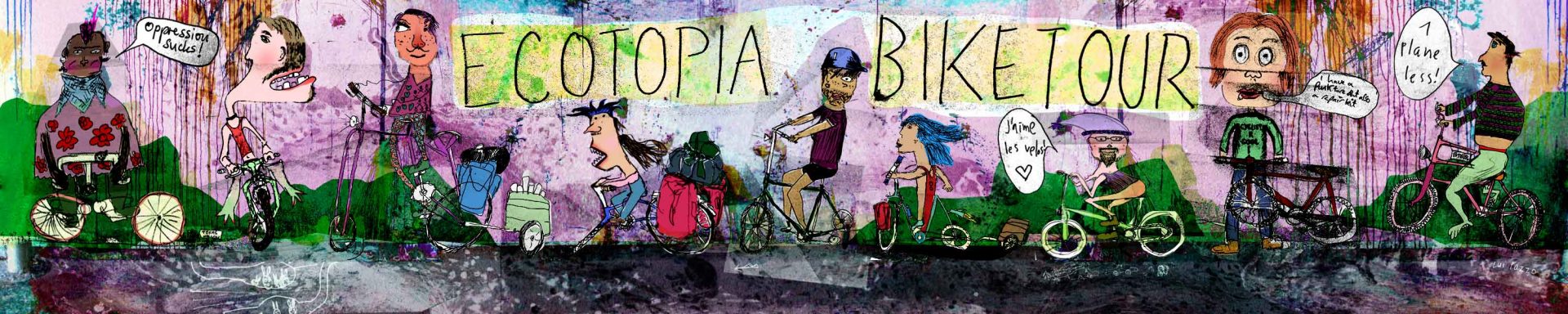
We use the word “orga” in the sense of “organizers”, not “organization”, to refer to people who are involved in planning the tours and take responsibility for the Biketour in the longer term.
The exact shape of orga may differ in different years. Because the way the Biketour is organized is fluid, with people taking on different amounts of tasks and joining and leaving at different times, there is currently (fall ‘26) no clear definition about who is part of orga and who isn’t. This page is a description of what it looks like currently, and none of it is set in stone.
The past years, orga has struggled with the question of how we can build structures that can rebalance the hierarchies created through oppression. We have also reflected and continue to reflect what is the role or orga and what reponsibility does it carry. We would love to think through these questions on the tour together with the other Ecotopia community members.
History
In the past, the Biketour has often been prepared by one or two “coordinators”. They were keeping an overview over the preparation process and did most of the work. Sometimes there were additional structures like regional coordinators for different parts of the route. Often, we applied for funding to pay the coordinators to be able to work on the preparation full-time.
Usually, it was hard to find anyone who would be willing to take on the huge responsibility of becoming a coordinator. In 2013 though, when the tour was planned to start in Berlin, we received more than 10 applications and had to select two of them, as that was a limitation imposed by the funding that we had applied for. Because this created dynamics quite similar to the capitalist competitive labour market, and because the concept of having two coordinators anyways contradicts the way we usually do things on the Biketour (where we try to share all responsibilities among everyone), a proposal was brought up to get rid of the two funded coordinator positions and instead try to prepare the tour as an open group where many people take on little tasks de-centrally and coordinate with each other online.
In 2015, this approach of an open preparation group was tried for the first time, and it turned out to work not so well (one person did most of the work alone). We could think of two reasons for this: Either only few people have the time to prepare the Biketour in their free-time, or the Biketour community is not yet used to the new approach and first needs to learn that it is necessary to contribute before joining the tour. During the tour in 2015, it was very clearly communicated that everyone’s initiative is needed to organize 2016.
The vision of this approach was that the orga would be a preparation group that is open to anyone interested in contributing in any way. Orga would make decisions about the general frame of the tour (values, dates and places, equipment) in advance of the tour, and as soon as the tour starts participants would be handed this general frame and make day-to-day decisions within this frame among themselves.
In the past years, orga has shifted into a semi-closed, continuously existing (not starting anew every year) group.
Why this change?
The tour is a long term project with decades of history, reputation, and information, and we want it to keep existing for a long time. We noticed that with an annually destroyed/created preparation group, no one was responsible for the long term interests of the tour. We noticed this especially when crisis happened on the tour. With a concept that “the current people on the tour are the Biketour”, there is a lot of responsibility on people who aren’t necessarily interested in this or equipped to care for it.
The people who are on the Biketour at any given moment can be people who join just for some days or weeks and who are interested in having a good time at the moment, but they aren’t incentivized to care about what happens at the rest of the tour, or what happens in future tours. During a crisis (for example toxic or oppressive behavior by one or more participants) the participants may not be equipped to deal with it because they’re only there for a short time and don’t have enough time to understand a conflict and get involved. The people harmed by the situation may also choose to not bring up the crisis because they only stay at the Biketour for a short time anyway. This creates a toxic culture where harm is not addressed and can continue and people who are harmed decide to not come back to the tour.
Another way we saw the long term and short term interests diverge was around communal equipment. Organizing the communal equipment takes a lot of time, energy, and money, but while on the tour this is often not visible. When the group gets smaller, less of the communal equipment is needed. People on the tour may decide to leave communal equipment or give it away instead of sending it to a central place where it can be used again for the next tour. This can make sense in the moment but creates more work and costs for the people preparing the next tour.
Orga Responsibilities
In short, the orga as a group is responsible for the Biketour. We understand the following parts of this. Note that the orga as a group is responsible for this and not everyone in orga is responsible for everything, and visions around what exactly is part of the orga responsibilities will also differ between orga members.
Prepare the tour
The main activities of the orga are around preparing the upcoming Biketour.
Culture and values
The role of the orga is to create or maintain a culture where bigotry and abusive behaviors aren’t tolerated, and where the Biketour stays aligned with its values.
Because the orga changes, the particular people who happen to be in orga at the moment may not be the same people who were there during a crisis. However, current orga has responsibility to deal with current crisis and prevent future crisis.
Longer term interests of the tour
This includes – but is not limited to – keeping in mind participants who are not currently on the tour but plan to join later (orga will argue against changing the route/rough schedule for trivial reasons as upcoming participants will already have booked their travels, etc). Other example may be cultivating and preserving a good reputation, public communication channels and maintaining trust, which is a vulnerable thing that takes years to build, and on which we rely when we knock doors, contact other people and groups and so on.
Data and safety
The orga is careful around the data of the projects and participants. There is a lot of sensitive information that orga has access to and that we want to be careful with. This includes information about the projects we will visit, participant registration including medical information and emergency contacts, and bank information for participants travel reimbursements. It is important especially that a piece of sensitive info once revealed can usually not be obscured anymore, particularly in the age of mass surveillance.
Documentation of orga work and skill-sharing
It is recommended in order to make future orga work easier by not reinventing the wheels:) Both for the group that does a certain task and even more for the newly joining people, which may also reduce the knowledge hierarchies, and to learn with time as a group.
Practically
how: We work online on the platform mattermost for communication, and outline for working on documents together. We have regular video calls. We organize in working groups. Once or twice a year we come together for one or two weeks to discuss things and work together on the Biketour.
time availability: In our experience, the energy and availability for orga is higher in the beginning of the orga year (starting in october), than in the end (closer to the beginning of the Biketour). It’s also easier to join orga at the beginning of the orga year when the plans are being made, than near the end. Therefore we recommend that people who want to join orga stay at least involved for the whole orga year, but this is not a requirement. Some people work on the biketour several hours per week, some take on a smaller project within the biketour, some only join orga for during the working weeks. It depends on people’s availability and energy. There is no minimal requirement for joining orga. Because part of the orga’s responsibility is the long term interests of the tour, it’s good when people stay involved for multiple years.
Examples of what the orga work can look like: the tour preparation part looks like researching a region’s road quality and weather averages, asking around and searching for project and event recommendations, contacting projects to see if the Biketour can visit there and coordinating with projects when we can visit, combining all the information of roads and projects to propose routes for the Biketour, applying for funding, organizing equipment, communication with the public, and more. For the culture and values part we often have discussions about how to improve Biketour structures or what our values are and how to communicate them.
Who can join?
Anyone who is interested can ask to join orga. We generally think it’s important that people have some experience with the Ecotopia Biketour so they know what it is that we’re trying to create.
When someone expresses interest in joining orga, the currently active orgas will make a decision on whether to welcome the new person, and will refuse someone if a current orga disagrees with including them. When we reject someone, we try to communicate why we are rejecting them and what needs to change for us to accept them. We aim to eventually include everyone who wants to join. Reasons for rejection can be misalignment with the tour’s core values, unsafe behavior, or something else.