I cycled for a few days alone with my 2-year old child on my bike with the special bike seat construction through Sweden towards the Biketour. I wanted to gain some experience and develop a routine before joining the group. It was the first time for my child to be on the bicycle for so long in a single day, the first time for them to camp in the wild, and the first time for me to biketour with a child.
Despite having a lot of experience travelling on the bike alone and taking tools and equipment for every possible scenario with me, I was quite nervous whether everything would go well with the bike and how my child would deal with the new experience. Everything worked out fine in the end and it was a great experience with a few challenges that I want to share with you here.
The landscape
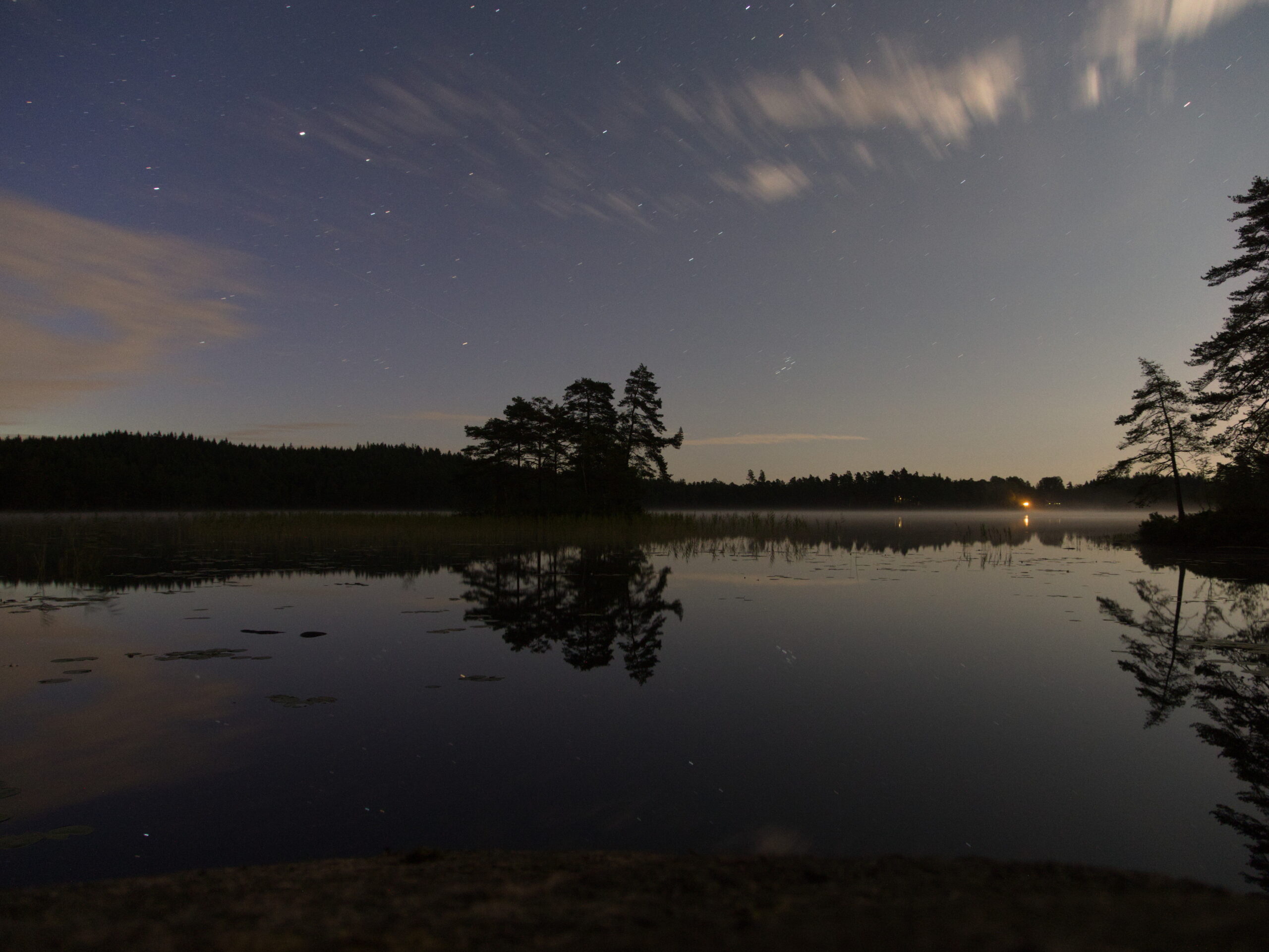
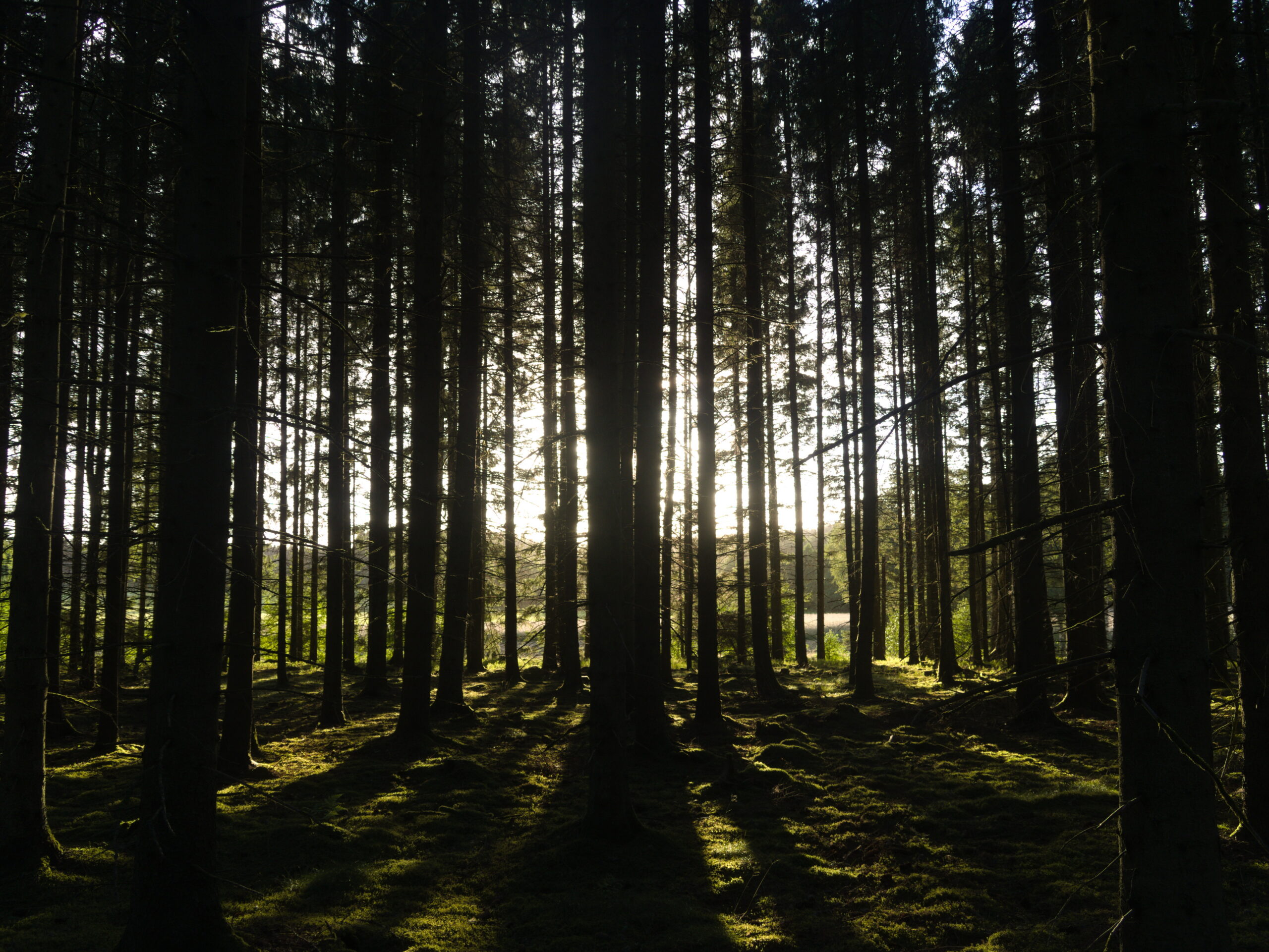
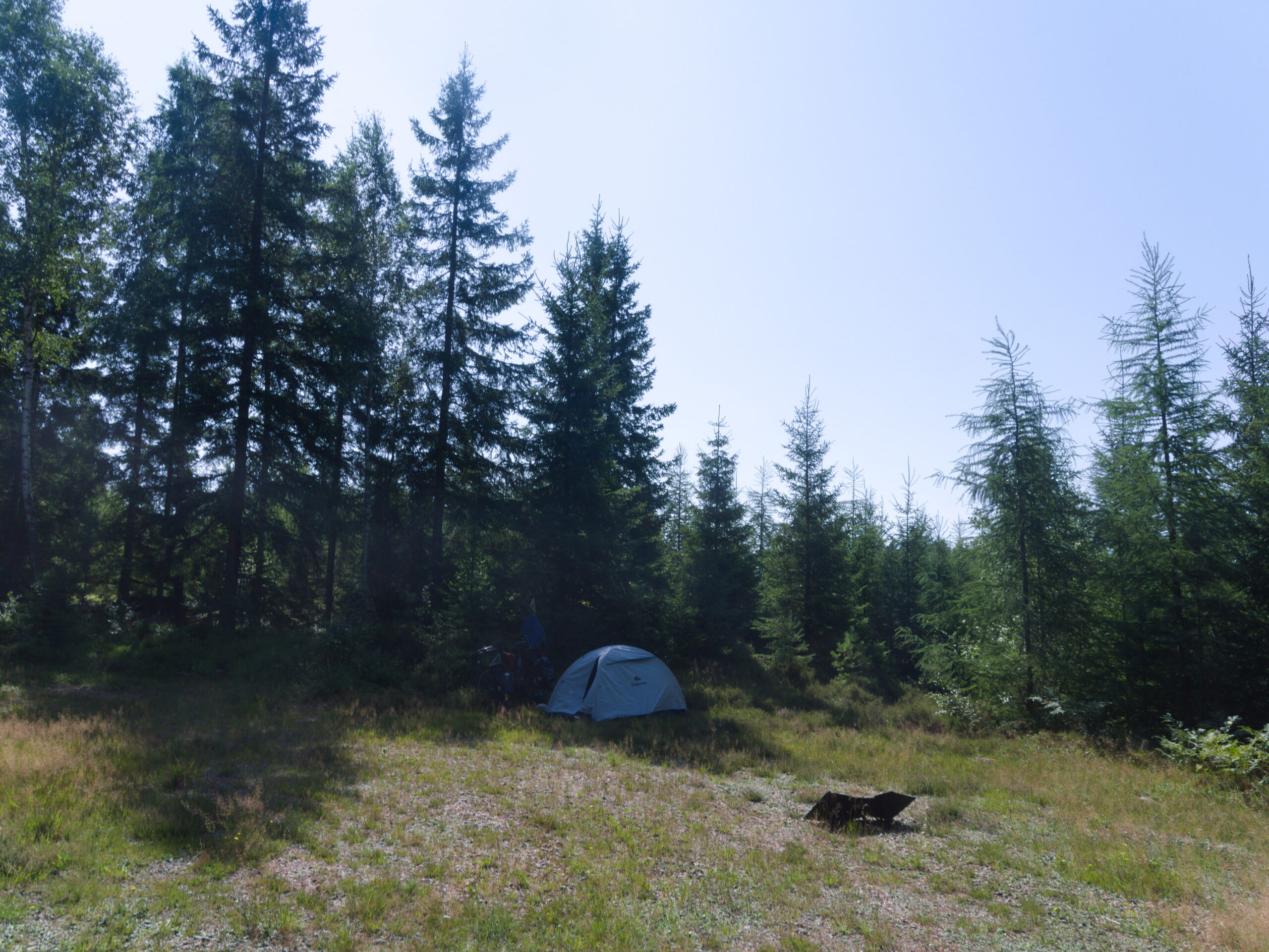
The landscape of southern Sweden was amazing to cycle through. After passing the windy fields of southern Skåne, I quickly ended up in a landscape of diverse forests full of moss and with bilberries and lingonberries growing all over the place. Looking at the map, it was a good decision to take the ferry to Ystad instead of Trelleborg, because from Trelleborg the distance to the forests would have been much longer, especially when following the coast.
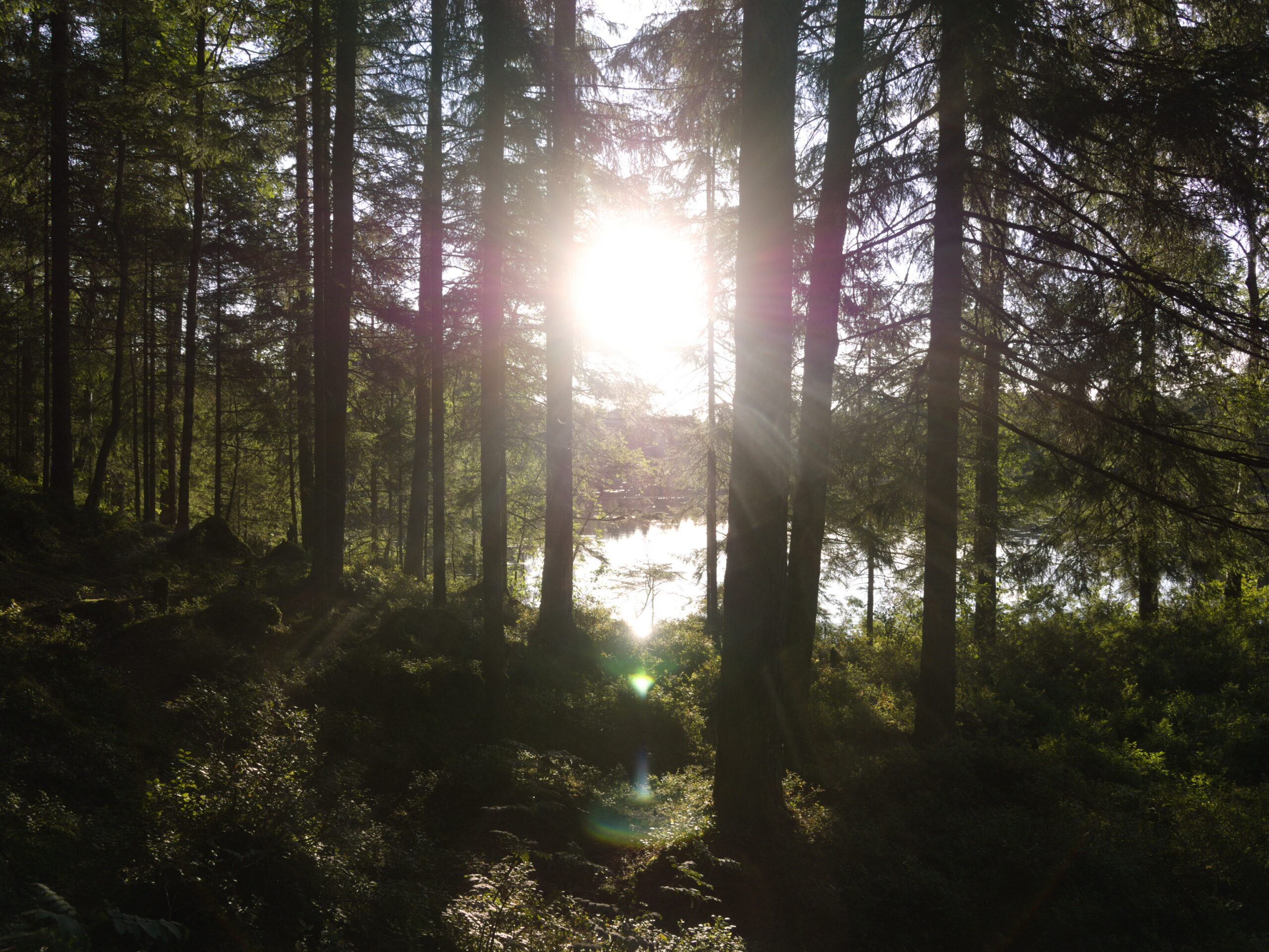
We also passed multiple lakes per hour. Knowing that there is the right to use and access them and to camp almost anywhere I want, and also a culture where this is accepted, made me appreciate the nature more. However, I also found out quickly that while it is allowed to camp almost anywhere, it is far from possible to do so. The ground is too soft, too wet or too bumpy in many places to even move a heavy bike across it, and the lakeshores are so overgrown in most places that it is impossible to reach the water even on foot. Where the lakeshore has been made accessible, it is usually for a house, so camping would be inappropriate there. To reliably find great camping spots, maps like CampWild or Vindskyddskartan can be used, where places with lake access, a fireplace and a small shelter can often be found. However, there are not that many of them that you would just spontaneously find one close to where you are, so some planning in advance is necessary.
The roads
I usually prefer to use big roads, as they are not only faster and more comfortable than small roads or bike paths, and I refuse the idea of using slower ways so that the cars can go faster, but also I have experienced them to be safer, because the longer-distance visibility and the wider roads allow cars to react earlier and better, as opposed to the deceptive safety especially of bike paths, where those places where cars and bicycles do meet require an active effort of all traffic participants to see each other, leading to a 5 to 10 times higher risk of being hit by a car than when using the road.
Having cycled in almost every country in Europe, I was shocked to discover that the big roads in Sweden are the worst in Europe for cycling safety, similar but even worse than the ones in Romania. They have been engineered to brutally sacrifice the lives of cyclists in order to make car drivers kill each other less. This is combined with a driving culture where on big roads, cars and especially trucks only slow down when it is actually physically impossible to pass a cyclist.
It generally seems to be allowed for cyclists to use any roads in Sweden that are not motorways. However, larger main roads are not wider than smaller main roads. There generally is a very small shoulder, maybe the width of half a handlebar. Sometimes that shoulder is made uncyclable because of grooves carved into it to warn drivers that are steering off course, but the shoulder is generally uncyclable with a lot of luggage and a moving child on the bike, where you cannot guarantee to go in a completely straight line.
On the largest of the large roads, the ones that are mapped as “trunk roads” and shown in orange on OpenStreetMap, there is a rope barrier both on the sides and in the middle of the road, despite there mostly being only one lane per direction. This forces cyclists with luggage to cycle even more in the middle of the road because the luggage would otherwise hit the barrier, and it encourages drivers to overtake with basically zero distance, because otherwise they would have to stay behind the cyclist for tens of kilometers, as the barrier in the middle is preventing overtaking with a safe distance.
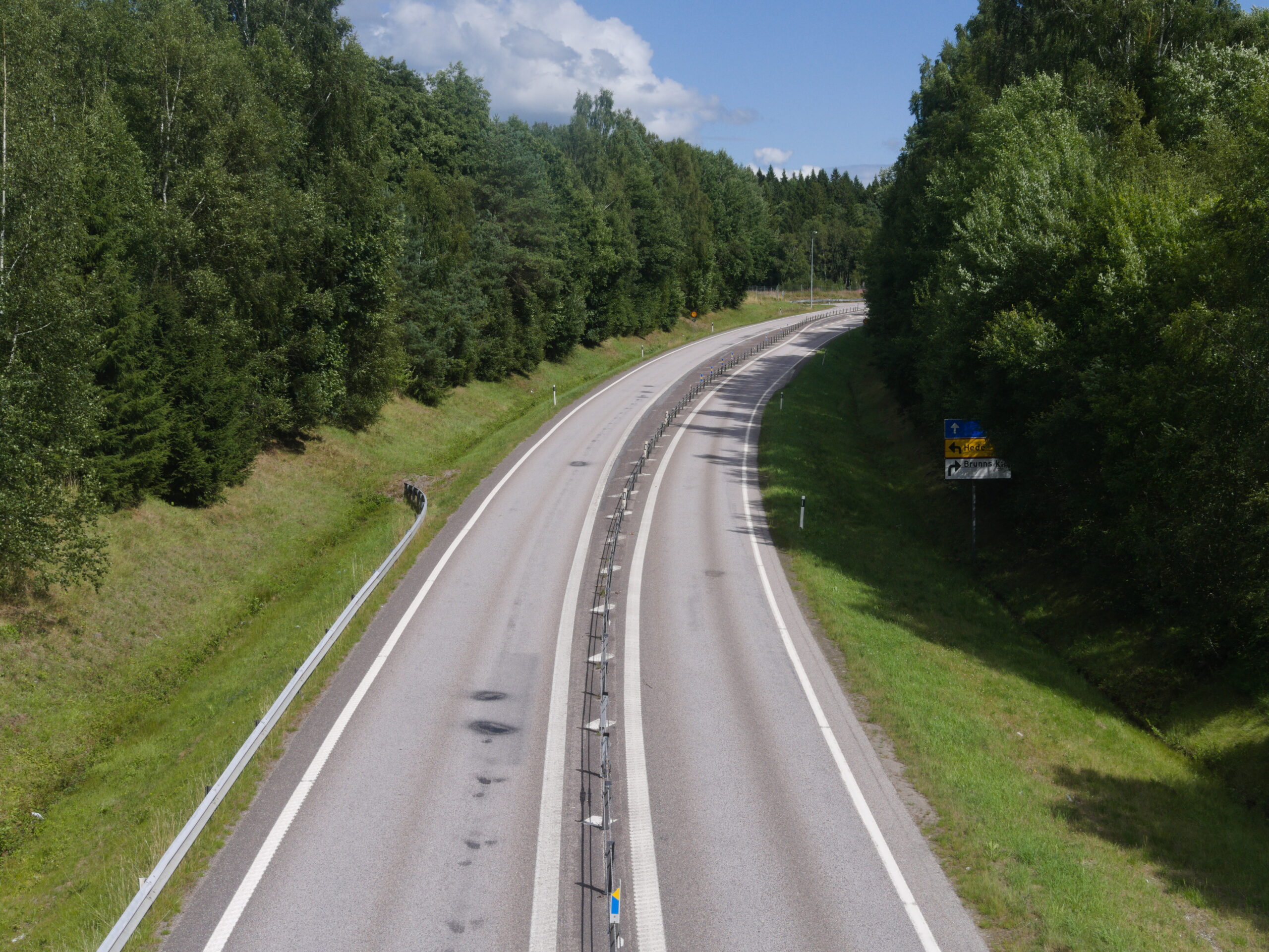
Who wants to cycle here?
But even on roads without those barriers, a lot of drivers, especially trucks, were not keeping a distance, even when there was space. I was shocked to be regularly overtaken by trucks (sometimes road trains of one full-length truck plus two trailers) at full speed with less than 50 cm of distance, while visibly having a small child on my bike. There seems to be no law about a minimum distance (not that such a law would change anything almost anywhere else), and it is up to the drivers to judge what is a “safe” passing distance.
This made me decide to use only small roads to reach my destination.
Many of the small roads in Sweden are gravel roads, and this is often not mapped, so you cannot know in advance. However, those gravel roads are usually “compacted”, and I must say that their surface is better than the average German paved cyclepath. I had no problem cycling on any of them, despite my heavy bike with strong tyre pressure normally struggling on gravel. There were only a few situations were softer gravel was combined with steep downhills that I had to be a bit careful.
There is a lot of infrastructure against bicycles in Sweden, but because of the low population density, it almost only exists inside towns. In the true manner of capitalist efficiency, each road is built in the cheapest way possible, and bicycles get punished for not damaging the road with asphalt that is only two centimeters thick and thus already bumpy when it is built. Fortunately, a new law allows cyclists to use roads if the speed limit is at most 50 km/h even if there is an accompanying bike path with the sign to be compulsory (the blue round one). This means that almost none of the infrastructure against bikes actually has to be used. Unrelated to the law, I found that drivers in Sweden are generally very unconfrontational, and I did not experience any assaults or attacks from motorists during my time there.
The hills
The landscape of the Nordic Countries is heavily shaped by the glaciers of the last ice ages. There are very few plains, and the landscape is wavy and full of small hills. The hills are everywhere and not big or steep enough to justify engineering the roads to avoid them, but big and steep enough for cyclists to feel them a lot. Cycling through Sweden basically means going up and down the whole day. On the smaller roads in particular some of the ascents are short but very steep, which was a big challenge with my heavy bicycle. For untrained cyclists, cycling in Sweden means a lot of walking the bike up the hills.
The infrastructure
The population and also the infrastructure in Sweden seems to be concentrated along some major corridors. The big roads follow these corridors, but taking small roads, one would have to make detours to follow them. On the small roads that I took, I was surprised that even in the more populated south of Sweden, the distance between shops was sometimes more than 100 km. What I wasn’t prepared for is how futuristic (in a bad way) some things in Sweden are. Sometimes the only shop available was only accessible to Swedish residents with a smartphone, as you would need a Swedish smartphone banking app to enter the shop and to pay at the self-checkout. This was not indicated in any way on the maps, so I guess I would have needed to read through the reviews on Google Maps to find out whether I would be even able to enter a specific shop.
Another issue that turned out to be challenging was drinking water. In general, there are very very few public drinking water taps in Sweden. In the big cities, there are many public buildings that can be accessed for free and where you can fill your water at the toilets inside, but on the countryside the only taps available are mostly on graveyards or sometimes at public toilets along major roads. I found that these are often not drinkable, but there is no sign indicating that. They seem to serve unfiltered groundwater or sometimes even lake water. I found that on some graveyards, there is one tap coming right out of the church building that has different water than the other taps and is drinkable, but this is not always the case and cannot be researched in advance. I was able to find a drinking water tap about every 50 km. There are many houses everywhere on the countryside where I could probably have asked, although I rarely saw any people there, so I don’t know if someone lives there or if they are just holiday homes.
One thing we enjoyed a lot were the playgrounds. Apart from the missing water taps, many of these had great infrastructure and great toys. There was usually a lot of space and often a beach, and usually picnic benches with tables and sometimes a toilet. The toys were really on another level, and I got the feeling that someone really invested thought and money into them. For example, some playgrounds had a “tandem” swing, where parent and child could sit on the same swing facing each other. Some playgrounds had sandboxes that were full of toys. The most challenging part about the playgrounds was convincing my child to ever leave again.
One challenge on the way was that with a bike so heavy and a child on it, the bike cannot stand on its own but needs something to lean against. This turned out to be more challenging than expected. In Sweden, most roads, even small ones, have ditches on both sides, and the trees are only behind them, so there is nothing to lean against. If there was a problem with my bike on the road, I wouldn’t usually be able to park it to work on it. Also, many times I saw berries along the road but couldn’t stop to pick them.
The child
I was very surprised how well this style of travelling worked with my child. Of course, children are extremely different from each other, so this does not say anything about other children.
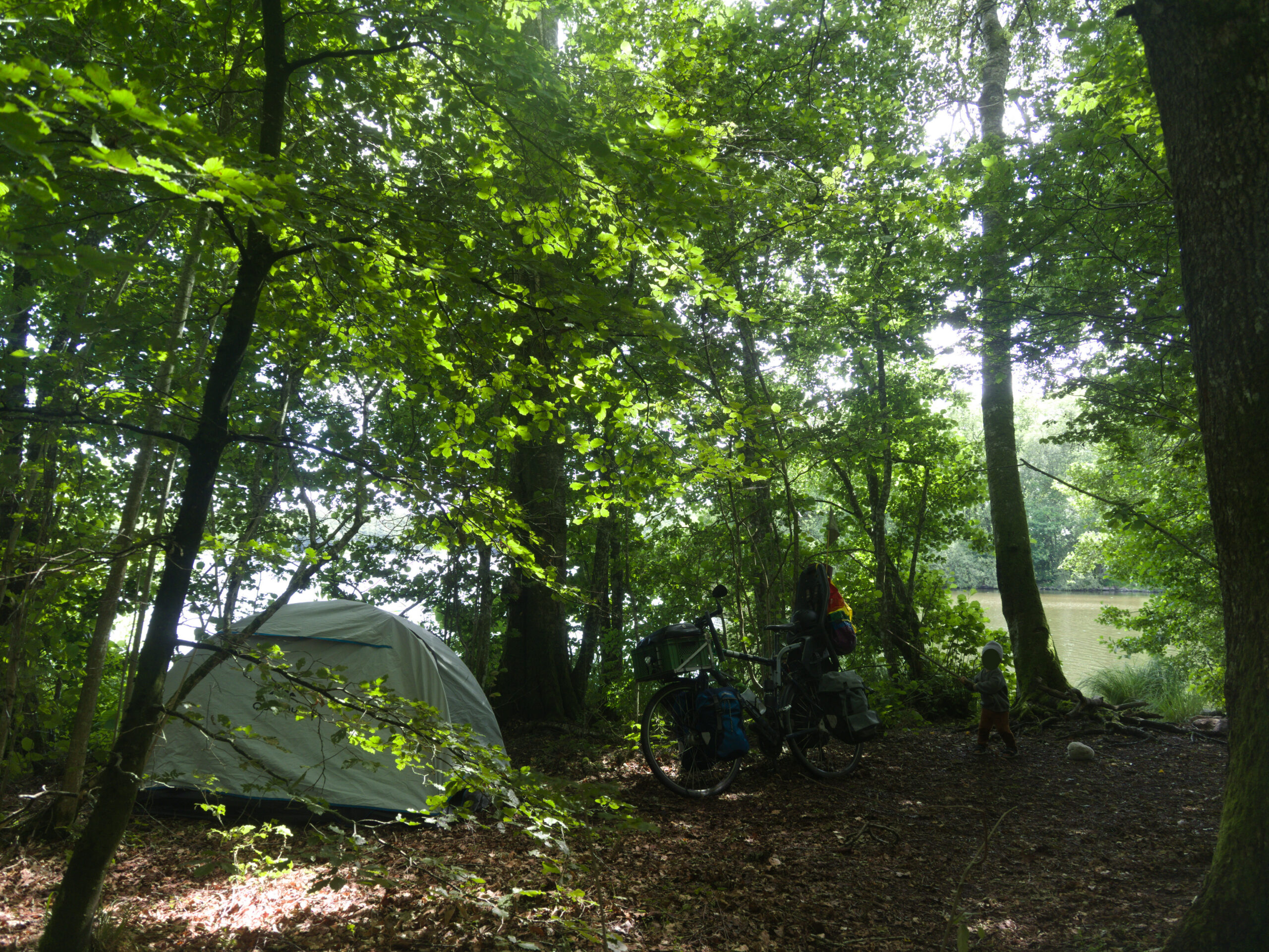
I found that in the simple life on the road, every step in the daily life (packing the tent, starting to cycle, taking breaks to eat, filling the water, getting food, pitching the tent) is so obvious and necessary that my child understood and felt each one of it and was excited to participate. We had almost no differences about what to do next, with the notable exception of leaving playgrounds. I could cycle almost as far each day as my body allowed.
I had the impression that it was a very valuable experience for my child. They learned to pitch the tent, to eat berries straight from the bushes, and to be excited about picnic benches, lakes and the forest in general. In the evening my child fell asleep very fast and without much drama, indicating that they were satisfied with the outcome of the day. Everything felt really harmonic and there was a lot less unhappiness than at home.
I specifically enjoyed the acceptance of wild-camping in Sweden with the child. When the child was unexpectedly crying in the tent, I would have been really stressed about people discovering us otherwise.
But I also noticed that travelling with a child is a hole other level of responsibility than travelling alone. I had two situations where something went wrong: Once my derailleur got stuck (because my setup exceeds its maximum capacity and I shifted into a “forbidden” gear), but fortunately it didn’t break and only the chain snapped, which I could fix quickly. Another time I got stomach problems from drinking bad water. Fortunately I was only knocked out for one evening, not for several days. With my bike already being so full with my stuff, my child’s stuff, and my child, I didn’t have space to take water and food with me for more than maybe 2 days. In those situations I noticed what a nightmare being stuck in a forest with my bike, or worse, my body not working, while the nearest supermarket, train station, bike shop or drinking water tap is 50 km away, would be.
The summary
With its beautiful nature, wild-camping possibilities and sparse population, Sweden seems like one of the most suitable places to do more biketours with children in the future. However, due to its sparse infrastructure, such a biketour requires advanced planning of shops, potential drinking water taps and possibly also sleeping places and rest stops with playgrounds in advance. It might be advisable to bring a water filter to be able to drink lake water. The exhausting hills need to be taken into consideration when estimating the daily distances.
Travelling alone with the child seems quite risky if something goes wrong. It would be better to be at least two adults so that one can get supplies while the other stays with the children.
It would be nice to organize a small children Biketour in the south of Sweden when the Ecotopia Biketour happens in a place too far to reach for people with children from northern Europe.